Showing posts with label James Cagney. Show all posts

Sunday, July 17, 2011

Angels With Dirty Faces (1938) — Whaddya hear, whaddya say?

It's the same every time. My recent annual re-watching of Yankee Doodle Dandy only whetted my appetite for more James Cagney. (Is he my favorite actor of the "classic" Hollywood era? He may have to arm wrestle Cary Grant for the title. Certainly both occupy a shifting cloud of my top-of-the-tops from the 1930s-'50s.) This time, though, I was ready for that whetting and so had a neighboring DVD already pulled from the shelf. It's one I hadn't seen in years, and I was pleased to discover that it still holds up to my memory of it.

In 1938 Warner Brothers took a stand in the nature/nurture debate, pointing a gangster melodrama, Michael Curtiz's Angels With Dirty Faces, squarely at the poverty, social dysfunction, and ineffectual judicial system that mold and ultimately doom gangland's Rocky Sullivan, memorably played by Cagney because, hey, who else?

It's a random dice-toss of chance — Rocky, a boy from the New York City slums, can't run as fast as his best pal Jerry on the day it counts most — that preordains the boy to come of age in reform schools and prisons, which educate him only in how to become a top-dog hoodlum.

Fifteen years later, Rocky is a natty, snazzy, hardened gangster newly released from prison when he visits his old tenement neighborhood to reunite with his boyhood pal Jerry, who's now a priest (Pat O'Brien, Cagney's real-life friend and frequent co-star).

Even through its contrived sentimentality and its position as the ground zero for generations' worth of Hollywood tropes, Angels remains a pinnacle achievement from the heyday of the Hollywood gangster cycle. Rocky Sullivan, like other toughs played by the charismatic Cagney in The Public Enemy and other hits, so sculpted the actor's public image that not even his footloose spin playing George M. Cohan in Yankee Doodle Dandy could shake it. The way Rocky hitches his shoulders remains a staple of Cagney impressions. Cagney took the mannerism, along with Rocky's catch-phrase "Whaddya hear, whaddya say?," from a streetcorner pimp he recalled from his own hard growing-up in Manhattan's Hell's Kitchen.


When Rocky returns to his old haunts, he encounters the new generation of young street thugs, played well by the Dead End Kids. It isn't long before the ruffians take the dapper, famous, and (in their eyes) enviably successful Rocky as a role model. Like Cagney himself, Rocky is spirited, often funny, and entirely self-directed. There's nothing false about his cocky swagger and rat-a-tat delivery.


His yin/yang equal is Father Jerry, now an activist social reformer as savvy and resolute as Rocky, and who's willing to manifest his compassion for his old pal through a right hook when the occasion calls for it.


While Rocky enjoys his Damn It Feels Good To Be A Gangster celebrity, Father Jerry is doing his best to keep the kids' hearts and minds out of harm's way. Therefore he's duty-bound (and divinely sanctioned) to disapprove and try to influence his friend — even while admitting that in the crap shoot of life Rocky has, outwardly if not inwardly, won the toss. Although fate split Rocky and Jerry on their divergent destinies long ago, the kids can still choose which path to take, and nobody sees that better than Jerry.


Meanwhile, Rocky attempts a hard-boiled romance with steely Ann Sheridan (another reunion from the old hood), and catches up with the racketeering gang that he took the fall for years ago. That's when he runs afoul of Humphrey Bogart as the slick, crooked lawyer who owes Rocky a hundred G's in stolen loot. When Bogart's bad-bad guy sets out to bump off Cagney's good-bad guy, we're rooting for Rocky all the way.


However, as the kids trade basketball in the parish church gym — Rocky's tough insistence that they play by the rules makes for one of my favorite scenes in '30s cinema — in exchange for high-profile living with ill-gotten dough and racking 'em up at the pool hall, we see that Father Jerry is correct and Rocky's influence on the vulnerable street kids can make a literally life or death difference.

The way Rocky takes care of his former cronies puts the cops on his tail. New York is gripped with gangster panic, the kids following his headline exploits as if he's a sports star. A blazing gunfight dovetails smoothly into one of the great Hollywood endings: Rocky's "last mile" walk and Jerry's appeal to his humanity for the sake of the kids who worship him as a hero. Rocky's final moments before the electric chair's sizzle — all shadows and the sound of Rocky's last words — pump up a climax that's as riveting as it is famously ambiguous.


Angels With Dirty Faces sure has aged well. There's a bowlful of old chestnuts in this pulpy parable where hardcore street toughs are named Soapy, Swing, Mim, Patsy, Hunky, and Crabface, but it's saved from the terminal trites by its prime-rib casting and ear-pleasing screenplay, to which Ben Hecht and Charles MacArthur contributed without credit. One of my favorite exchanges is apparently also one of Quentin Tarantino's, who modified it only slightly for the opening scene of Reservoir Dogs:

Soapy: "Hey! Call a fair game or I'll slap you right in the kisser!"
Rocky: "You'll slap me? You slap me in a dream, you better wake up and apologize."

It all moves crisply forward under the gifted hand of director Curtiz, who kept the pace lively and the imagery genre-perfect. (1938 saw four more Curtiz films, including The Adventures of Robin Hood.) Even clichés such as the kids' dime paperback street patois ("I didn't say a woid!") and the newspaper headlines rushing toward the camera still somehow feel fresh and appropriate.


I want to give a special shout-out here to actor Frankie Burke, who at the old age of 23 appears in the early scenes playing young Rocky as a boy. Although he made other films after Angels, this is the role he's remembered for. And there's no wondering why — the guy's such a dead ringer for Cagney that I found myself wondering if the part was actually Cagney somehow playing Rocky as a teenager. The look, the talk, the mannerisms, it's all there and there's no question that this kid is going to grow up to be Cagney's character. Apparently it was a role Frankie (real name Francis Vaselle Aiello) was born to play. According to his IMDb bio, he was a Brooklyn kid who grew up hooked on Cagney in the movies.
"He imitated Cagney for a long time to his friends and family, much to their approval, before deciding to hitchhike to Hollywood to get an interview with Cagney, but this attempt failed, so he returned home to New York. Later he tried it again, and this time he landed a job on the vaudeville circuit doing impressions of Cagney. A Warner Bros. talent scout saw his act and hired him for the role of the young version of Cagney's Rocky Sullivan' in Angels with Dirty Faces (1938)."
Some 17 mostly forgotten films later, his story takes a spin toward the peculiar:
"His whereabouts from 1941 to about 1961 are unknown, but sometime in the early 1960s, he decided to ride the rails as what he, himself, called a 'Hobo' until he became too ill and was taken from a train when it pulled into Junction City, Kansas. He was diagnosed with terminal lung cancer and sent to a long term care facility in Chapman, Kansas where he passed away only weeks later on April 7th, 1983."
The bio is hardly official and not what we'd call professionally written ("he sat in the lobby for weeks every day"). It was apparently provided by the proprietor of a (rather, the) Frankie Burke fan site, so while there's no other way to authenticate the info, there's no doubting its earnestness — or Burke's uncanny turn in the role.

Then there's Leo Gorcey, the pugnacious leader of the original Dead End Kids, who almost gained another vector of immortality by almost making it onto the Beatles' Sgt. Pepper album cover, complete with his Angels Jughead hat. It seems that a paltry fee of $400 demanded by either Gorcey or his agent (accounts differ) was the sticking point.


Angels With Dirty Faces shows that the studios — particularly Warner Bros. with its distinctive house style and contract players — could produce good work even when knuckling under to the Thou-Shalt-Nots of the Production Code's killjoy moralizing (the original conformist "PC"). There's plenty of gunfire, but no blood or corpses; the "coppers" are shown as embodiments of Law & Order while Rocky and the other criminals are punished by early death and ignominy. It's suggested that Ann Sheridan's Laury didn't exactly live the wholesome life before her husband got gunned down and Father Jerry rescued her, but the script dodges any unsavory details.

And yet that obeisance to the Code pushed the screenplay toward its most interesting highlight — the unveiling of murderous thug Rocky Sullivan's layers and nuances, the "good kid" he could have been showing through the hardened outer shell he grew while bouncing in and out of the joint. His final seconds in the Death House, and the sacrifice they represent, turn the character inside out, potentially making this brutal gangster one of Hollywood's great screen heroes.

Cagney leaped at the role as a means to stretch his range on the screen, and everybody noticed. It earned him the New York Film Critics Award and his first Best Actor Oscar nomination.

As a Cagney gangster picture with a marshmallow center, it contrasts in interesting ways alongside The Public Enemy from seven years earlier and especially White Heat eleven years later. What a fine triple-feature DVD night that would be.

These days, we note wryly that this Depression-era film's "society is to blame" text, and the Code's dictates on how lawmen and criminals must be portrayed, make a perhaps humbling red-state/blue-state unity. The whole "crime doesn't pay" trope has never felt more quaint than it does today, but the way Angels With Dirty Faces balances hard-bitten gangster drama with warmly stage-managed religiosity gives us an entertaining period piece, one which shows that after more than seventy years you still can't go wrong with a Jimmy Cagney movie.

Sunday, July 3, 2011

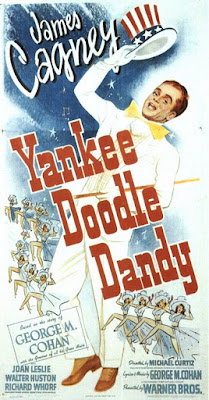
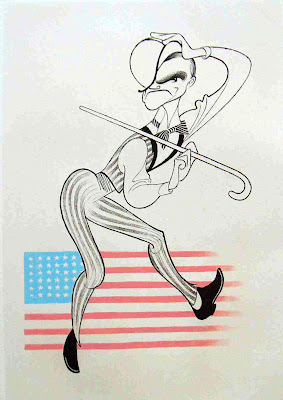
Yankee Doodle Dandy (1942) — It's a grand ol' film

This movie, on this particular U.S. national holiday weekend, is such an obvious title I'm almost embarrassed. Still, this musical biopic's apple pie Americana is to Independence Day what It's a Wonderful Life is to Christmas. Turner Classic Movies once again has it scheduled on the big day, as traditional as turkey at Thanksgiving.

Far be it from me to knock such a fine tradition.

It may be as corny as the Uncle Sam on stilts leading a Flag Day parade, but Yankee Doodle Dandy stars the irresistibly watchable James Cagney in a high-flying hagiography of actor-hoofer-songwriter-playwright George M. Cohan, the vaudevillian child star who grew into the brassy toast of the Great White Way. Today he's best known for composing standards such as "Give My Regards to Broadway," "Over There," "Grand Ol' Flag," and "Yankee Doodle Dandy," songs that helped a nation get through World War I and beyond.

Now, in any alternate universe where this movie was never made, I wouldn't give George M. Cohan a second thought. Even a first would be a peculiar occurrence. And my personal patriotism, which comes with a benign foundation of measured cynicism, desires little truck with the sort of treacly sentiment that comes thick as Vermont molasses in January.

And yet. Every year at this time I give Yankee Doodle Dandy a spin and there's Cagney getting me to sing along — or at least hum and toe-tap — with his only-in-Hollywood incarnation of that bygone era's Broadway triple threat. It doesn't hurt that he comes packaged in the high level of movie-making craft that you expect from Warner Brothers in its era of The Maltese Falcon and Casablanca.


Hollywood never let facts get in the way of a good story (e.g., Cohan had two wives, neither first-named Mary), and this is Hollywood at its myth-making, revisionist best. Yes, the material is hackneyed. The opening setup with the the gray-haired, long-established Cohan meeting with FDR in the White House includes both a discomfiting black servant stereotype and FDR's voice unconvincingly overdubbed by an uncredited Art Gilmore. The way that scene kicks off the remaining film's structure — "It started with a pretty funny incident about sixty years ago..." cue flashback — might elicit a stifled chuckle.

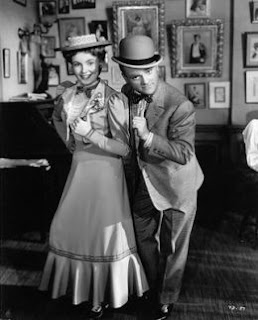
But you can't take your eyes off that powerhouse Cagney for a second. He reached back to his Broadway roots to play song-and-dance man Cohan. He infuses his interpretation of Cohan with the ka-pow! energy and charisma that make his gangster roles so memorable. Favorite scenes include Cohan and his future wife Mary (Joan Leslie) meeting cute, the deathbed moment with his father (Walter Huston), and Cohan taking Broadway by storm.

Production began the day after Pearl Harbor, which the cast heard about huddled around the studio radio. When the movie premiered on Memorial Day 1942, the war was not going well for U.S. forces, so the upbeat story and musical numbers were the Fourth of July sparklers that World War II audiences needed. Yankee Doodle Dandy became Warner Brothers' top-grossing movie of the year and its top-grosser to that time.

Directed by Warner's versatile workhorse Michael Curtiz, Yankee Doodle Dandy is as much a part of America-at-war 1942 as Curtiz's Casablanca, which premiered the same year. Like that Bogart classic, Yankee Doodle Dandy represents the best of its breed, in this case the rags-to-riches, feel-good story of success achieved through equal parts determination, talent, and good ol' American pluck.

Because Curtiz allowed him to improvise while the cameras rolled, Cagney proved that he was more than just the hard-bitten gangsters that had made him a top screen tough guy in hits such as The Public Enemy and Angels With Dirty Faces.

At only 5'-6" he was a nimble and agile dynamo. When his Cohan performs "Yankee Doodle Dandy" on Broadway we get one of the great Hollywood musical numbers. During the scene in which Cohan says goodbye to his dying father, Cagney's performance so moved the typically imperturbable Curtiz that the director began bawling and ruined a take.

A clear moment of Cagney's spontaneity occurs at the end when George, descending the White House stairs after a happy meeting with FDR, glides effortlessly into a tap-dance.


Said Cagney about it later, "I didn't think of it till five minutes before I went on. And I didn't check with the director or anything; I just did it." It's said to have been Cagney's personal favorite bit in the film. (I've stopped trying to replicate the moves while going down the steps to my Movie Room. It frightened the dog.)

Granted, besides Cagney the rest of the movie can be ... well, not a slog, really, but there is a reason why nowadays I do the Favorite Parts shuffle by fast-forwarding or chapter-skipping between the scenes where Cagney shows his stuff. Much of the narrative is too pat and by-the-book, and the hokum can get layered on like the dessert special at Applebee's. The romance between George M. and Mary is perfunctory, with Cagney and Joan Leslie generating little spark while still charmingly and obligingly fulfilling that requisite part of the plot.

Toward the end, the musical extravaganzas "Over There" and (the most shameless) "Grand Ol' Flag" (TCM clip) are magnificently produced but plainly aimed at rousing a movie-going audience to full-throated patriotic singalong — which is nice and "rah rah" and successful in their wartime, flag-waving, "America, Fuck Yeah!" aspirations, but they do shovel the corn into our laps while simultaneously hoping we stand up and cheer.

No matter. They're worth having if it means we also get Cagney's electric, spring-loaded, tour de force Broadway number surrounding the title song and "Give My Regards to Broadway," a scene that never fails to jolt me out of any torpor I might be in. A partial TCM clip is here.

I always love seeing S. K. Sakall again, the same year he immortalized Carl the headwaiter at Rick's Cafe.

As George M.'s showbiz family, the Four Cohans, rises from a traveling vaudeville act to bright lights fame and acclaim, Cagney's contribution to our collective Movie Quotes memory — "My mother thanks you, my father thanks you, my sister thanks you, and I thank you" — is a moving leitmotif, especially during Walter Huston's final scene, when George becomes the last of the Four Cohans left.

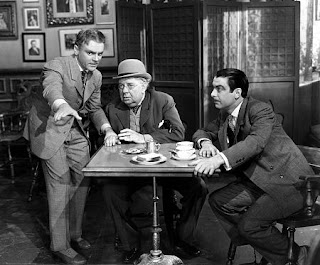
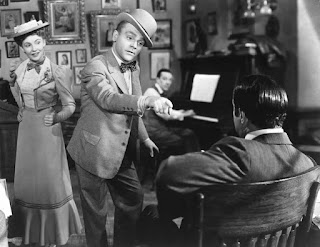
In George and Mary's "Harrigan" audition scene (TCM clip) Richard Whorf plays Sam Harris, Cohan’s long-time partner who ultimately became a famously prodigious Broadway theatrical producer. (My wife Elizabeth's mother, who as a young woman was a sometimes actress alongside Henry Fonda and Lloyd Bridges at the Westchester Playhouse summer rep, received an invitation to audition for Sam Harris, but her starched and conservative family forbade it; it's now one of our family's great "What if?" ponderables that always comes up during Yankee Doodle Dandy.)

Its eight Academy Award nominations included Best Picture, Director, and Writing. It won three, with Cagney's only Best Actor statue being the biggie.

Cagney regarded this as his favorite film. The Budapest-born, English-challenged Curtiz described it as "the pinochle of my career."

Quaint and nostalgic and with no hint of postmodern irony, Yankee Doodle Dandy points to that More Innocent Time™ we keep hearing about but that never really existed outside of selective, revisionist memory. It delivers its red-white-and-blue patriotism to you by the exuberant bushel, yet this grand old film reminds us that there was a time when, for some, patriotism was more heartfelt and joyful than bullying and teabagged.


As a DVD, Warner Brothers' two-disc Special Edition stands up and salutes with a gorgeous print and transfer that make the black-and-white cinematography, by the masterful James Wong Howe, a thing of beauty all by itself. Likewise, the Dolby Digital 1.0 monaural audio has been cleaned and bolstered to the hilt. (The film won the Oscar for Best Sound, Recording.)

The disc's list of supplements starts with film historian Rudy Behlmer's enthusiastic, info-packed commentary track. 

James Cagney: Top of the World is a fine biographical documentary hosted by Michael J. Fox.  

Let Freedom Sing!: The Story of Yankee Doodle Dandy offers a comprehensive production retrospective with insights from Joan Leslie, John Travolta, Joel Grey, film historians Behlmer, Bob Thomas, and Robert Osborne, biographer David Collins, and more.

In a five-minute solo piece, Travolta movingly reveals how Cagney influenced his life professionally and personally.

Finally, Warner Night at the Movies takes us back to 1942, when a ticket stub bought you Looney Tunes shorts (in this instance a theme-matched pairing, Yankee Doodle Daffy and Yankee Doodle Bugs), a newsreel, and coming attractions before the feature. You, John Jones is an inspirational wartime propaganda short starring Cagney and directed by Mervyn LeRoy.


Music: Howard Hanson, Symphony No. 2
Near at hand: Pub sign reading "The Sherlock Holmes
, London, England"

Sunday, June 6, 2010

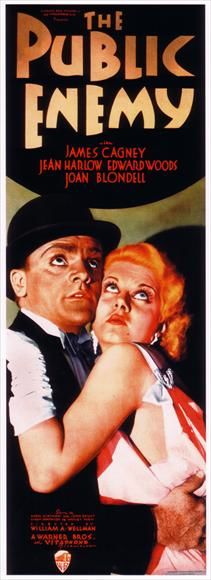
Alternate universe movies: "The Public Enemy" with Louise Brooks instead of Jean Harlow

I do love a good Cagney movie. White Heat, Angels with Dirty Faces, Yankee Doodle Dandy....

Like Bogart or Ingrid Bergman or Cary Grant, James Cagney is one of those vintage Hollywood actors who compels me to stop and watch while channel-flipping, who occupy an amount of shelf space among the DVDs I dip into when I'm, say, "in the mood for a Cagney movie" the same way I get in the mood for a good burger or a familiar favorite album in my iTunes library.

Among my favorite bits in movie-ized Shakespeare is Cagney's roisterous comic turn as Bottom in Warner Bros.' 1935 version of A Midsummer Night's Dream, a peculiar viewing experience if you know Cagney only from the tough-guy roles that helped make him an icon of his era. Those roles had already started by then, thanks to his head-turning breakout performance in 1931's The Public Enemy. This is the movie that made a star out of Warner contract player Cagney, who thereafter embodied no-bullshit gangster cool for generations.

Alongside '31's Little Caesar and the following year's Scarface, The Public Enemy made the pulpy tommy-gun melodramas into something, as Box Office said at the time, "absolutely serious from start to finish," something "meant to be taken seriously by the audience." The New York Times noted Warners' "laudable motive" of "apprising the audience that the hoodlums and terrorists of the underworld must be exposed and the glamour ripped from them," and the film's moral that "civilization is on her knees and inquiring loudly as to what is to be done."

Nonetheless, up until the final reel, in The Public Enemy the wages of sin are obvious: a kid street punk with an abusive dad and a talent for petty crime can grow up to be a big-shot racketeer with loads of dough, flashy cars, tailored suits, and beautiful, willing dames. (Too bad about that final reel, but it's a good one too.) The film did such an effective job of showing that, yes, Damn It Feels Good To Be A Gangsta, its prologue and epilogue disclaimers extolling its wholesome social intentions failed to budge the delicate bluenose pressure groups such as the Daughters of the American Revolution and the League of Decency. The Public Enemy's violent realism, scenes blatant in their sexual suggestiveness, and the snappy allure of Cagney's performance helped ring in Hollywood's self-censoring Production Code of 1934, which sanitized criminal and sexual subject matter for years.

Under the masterful guidance of director William A. "Wild Bill" Wellman, Cagney gives The Public Enemy its dynamism and rewatchability. No one else onscreen can hold a candle to him. Originally, Cagney and co-star Edward Woods (as Powers' life-long pal and partner in crime) were cast with their parts here reversed, Woods having the lead role as Powers. But after catching sight of Cagney in action in another film, studio bosses flipped the casting just before shooting began.

With Cagney in the lead, it was guaranteed that volatile mobster Tom Powers was the most attractive and captivating force on the screen. His success proved, if by then there was any doubt, that audiences will go for a charismatic lowlife over a dull hero any day of the week, a lesson Hollywood never forgot.

Cagney's body language and his ease with street-level speech — a holdover from his own youth on the streets of New York City's Hell's Kitchen — were a revelation. Tom was no cartoonish caricature of a thug, and the reviews of the day praised Cagney's naturalism as part of the film's realism. In the documentary featurette on the DVD, Martin Scorsese says that before he shot The Aviator he showed his cast The Public Enemy, and when Cagney's entrance arrived someone exclaimed "Modern screen acting begins."

Keep that "modern screen acting" thought in mind — I'm coming back to that in a moment.

The Public Enemy is, of course, the movie that gave us the most famous grapefruit in Hollywood history:


That's Mae Clarke getting the citrus in the kisser, a moment that took on a life of its own in the decades since (it has even been parodied on The Simpsons) and that has an uncertain origin story. (TCM's page on the film probably provides the best summary.) Clarke is one of several women in the life of Cagney's brutal yet magnetic gangster.

Taking second billing after Cagney is Jean Harlow as the classic bottle-blond Other Woman. Unfortunately, while the rest of the film's "girls" (among them Joan Blondell) are fine, the clanging exception is Harlow, whose line-readings sound so leaden and amateurish that not even Cagney can save her.

One of a harem's worth of Howard Hughes discoveries, Harlow was already a star thanks to Hughes' Hell's Angels the year before. Her lack of acting talent didn't go unmentioned by the critics, although Variety, in its review of Hell's Angels, wisely observed that, "It doesn't matter what degree of talent she possesses ... nobody ever starved possessing what she's got." Regarding The Public Enemy, Variety added, "Harlow better hurry and do something about her voice. She doesn't get the best of it alongside Clarke and Blondell."

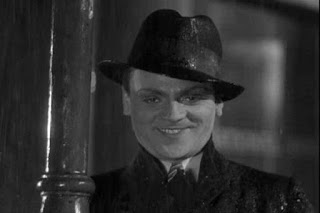
I wish I could find an online video of the Harlow-Cagney scene in the image up there to the right. In it her nails-on-a-blackboard voice and unconvincing performance just drain the juice from the scene, illustrating my thesis perfectly. Still, here's the scene where Cagney and Harlow meet:


As much as I enjoy The Public Enemy, Harlow is the bug in the fruit salad for me.


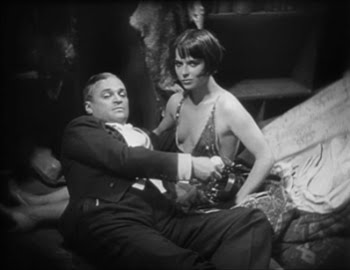
However, when I listened to the DVD's thorough commentary track by author Robert Sklar, I discovered that William Wellman, who had directed actress Louise Brooks three years earlier in Beggars of Life, originally offered her the role that Harlow lead-balloons here. At first Brooks accepted the part, but then changed her mind and went to New York. That decision began the end of her too-short career, and kicked off the decades-long professional and personal downturns that followed.

One of filmdom's rare sui generis evocative beauties, Brooks is best known today for her starring presence as the loose-living showgirl Lulu in German director G.W. Pabst's 1929 classic, Pandora's Box. It's one of the great films of the silent era, which was by then all but subsumed by the talkies.

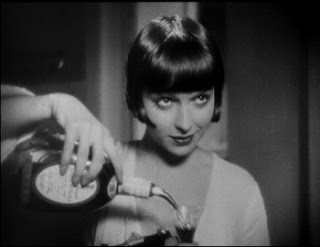
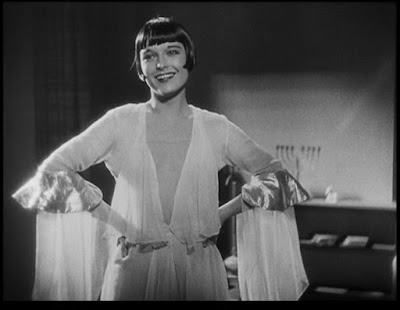
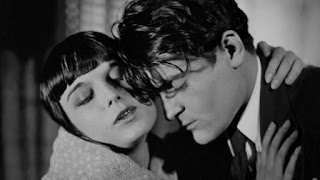
Pandora's Box gives us an easy dozen images that snapshot our popular impression of Louise Brooks — that exquisite face, which seems made for close-ups; that jet-black helmet-cut bob; an effortless eroticism; a delicacy that's too joyful for a femme fatale yet too knowing for a mere naif.

Pabst had been so struck by Brooks' brief role in Howard Hawks' A Girl in Every Port that he insisted on casting her as the lead in Pandora's Box — after a two-year search for an actress to play the well-established German character Lulu (a search comparable to that for Scarlett O'Hara). Pabst created something of a national scandal when he rejected Marlene Dietrich, a bona fide German star, in favor of this minor Hollywood American player. Brooks ditched Paramount (no love lost on either side) and headed to Berlin.

Pabst treated her with a regard and respect that Hollywood had never given her, even though she irked him by relishing Berlin's "life is a cabaret" energy to a degree that would make Sally Bowles blush. (She later made it up to him by giving the director one night of what she described in her essays as her greatest sexual performance.) While in Europe she made Pandora's Box and Pabst's Diary of a Lost Girl, then Prix de Beauté in France, a project begun with René Clair. Because of these films — although they were not well-received in their time and played in the U.S. and elsewhere muddled by heavily censored recuts — her eventual status as a beloved screen favorite was only waiting to be carved into our cultural marble.

Give all due credit to Pabst, but Brooksie pretty much single-handedly raises Pandora's Box above the doomed-bad-girl melodrama, the kind of one-tone moralistic parable so common in its time. Her deft, restrained performance of "tragic Lulu with no sense of sin" (as Brooks later described her) lifts the script with layers and shadings that wouldn't become common aims for years afterward. The Kansas-born actress didn't choose to play Lulu as a malevolent vamp knowingly attracting then destroying men beneath her heels (Marlene Dietrich would have fallen into that mode with one snarly look), or as some pre-War "Candy," an innocent unaware of the way men and women react to her sexually catalytic presence. Instead she walked that tightrope so tactfully that with repeat viewings we see more within her and may interpret her actions differently with every nuance. She made Lulu unfathomable, a well that always has more to give.

Brooks was not a trained actress. Despite that — or maybe because of it — she brought to the screen a performance style that's regarded as years ahead of its time in its naturalism and lack of pretense. As Brooks herself wrote,
"The great art of films does not consist of descriptive movement of face and body, but in the movements of thought and soul transmitted in a kind of intense isolation." 
In other words, film allows an actor to be not merely an animatronic puppet, but a communicator of a character's (and/or the actor's) innermost "thought and soul." In her later journals, she criticized a Garbo performance by noting that "She strains terribly... Is made to read line on top of line without pauses for mental transitions."

Watching Brooks today, we're bowled over by how modern she is, how subtle and unaffected. It's as if she intuitively understood that there's more "transmitted" power in a focused laser beam than in a wide-open spotlight.

Critics today laud Brooks' performance in Pandora's Box for the same modernity we see in Cagney's Tom Powers, and she did it two years before Cagney's entrance.

So it stabs me in the heart to learn that The Public Enemy might have teamed up Cagney and Brooks.

It's a pairing that would have changed the movie enormously, offering an altogether different heft and "reading" to the scenes between Powers and his mistress. Instead of Harlow diminishing those scenes (and the film), Brooks would have amplified and magnified them.

It's hard to imagine Brooks out-acting Cagney, but it's painfully easy to imagine the two of them together working so well that cinema might have witnessed as elemental a pairing as Bogey and Bacall, Hepburn and Tracy, or hydrogen and oxygen. Movies generally, and perhaps the social order, might be different today somehow.


Regrettably for us, Brooks detested Hollywood and its "play along to get along" ethos. As an actress, not to mention as an unapologetic sexual and professional maverick, she was ambitious but reckless. Cocksure but difficult to the point of self-destructive. Independent, emancipated, and willful but too damn temperamental and mercurial to commit to any situation — jobs, husbands, lovers, Hollywood studios — long enough to really get serious roots dug in. She described herself as "a born loner, who was temporarily deflected from the hermit's path by a career in the theatre and films."

It's a "What if?" that colors my viewing of The Public Enemy as I gnash my teeth through Harlow's grating performance. As with my previous Alternate Universe Movies post — "The Maltese Falcon" with Gene Tierney instead of Mary Astor — it's one of those often frustrating ponderables that emerges from the movies' long history of accidental convergences and tauntingly unfulfilled possibilities.


There's an excellent documentary about Brooks, Looking for Lulu, narrated by Shirley MacLaine and produced by Hugh Hefner for Turner Classic Movies. It used to be available on YouTube in six parts, but it's gone now. Find it if you can.

Also, there's much to see at Thomas Gladysz's Louise Brooks Society.


Music: Melody Gardot, Live from Soho
Near at hand: Balls of yarn Elizabeth has left in medias res.