Showing posts with label 1961. Show all posts

Friday, October 7, 2011

Octoberfilms: "House of Usher" & "The Pit and the Pendulum" (1960, '61) — Poe-try in motion


It's another DVD double-discer this time. We're talking not just a veritable pair of Vincent Price performances, but American International Pictures' first two of eight moody, broody films adapted from (actually, more "kind of inspired by, a little, sort of, if you squint") Edgar Allan Poe's atmospheric horror tales.

Sharing the marquee lights with Price is their producer/director, B-maestro Roger Corman, probably Hollywood's most capable director to ever squeeze blood from a long line of low-budget turnips. It's Corman who convinced AIP's cost-conscious chieftains, Sam Arkoff and James H. Nicholson, that for the price of two of the black-and-white drive-in monster flicks that had been Corman's stock in trade in the 1950s — It Conquered the World, Attack of the Crab Monsters, Teenage Cave Man, multiple etceteras — they could instead shift gears and increase their butts-in-seats quotient with a full-color Panavision widescreen macabre chiller "based on" a higher-browed commodity.

At first, Arkoff and Nicholson balked, stuck thinking that there's no way these rock-and-roll kids would drop their dollars to see a movie derived from a dead poet their teachers forced them to read in school. However, Corman's shrewd move of bundling his proposal with established star Vincent Price and successful novelist-screenwriter Richard Matheson sweetened the package. Besides, over in the U.K. newly revamped versions of Frankenstein and Dracula had just put Hammer Films and a goosed-up horror-film biz on the map, so why shouldn't AIP be the American outfit to mine the gold in costume gothic frights?

Courtesy Greenbriar Picture Shows
Especially now to our horror-jaded eyes fifty years on, House of Usher (aka Fall of the House of Usher and The Mysterious House of Usher) and its follow-up The Pit and the Pendulum are modest efforts, talky and downtempo, arch and affected. But Corman seemed to congenitally know how to fill a frame and touch our deep-down buttons, and each film is a noteworthy landmark in shoestring-budget filmmaking. Watch them one after the other and you can see the sharp amping-up of Corman's talent and his demonstrable ability to make a dollar look like ten. Or at least seven.

His reward was a level of critical and, more importantly, commercial success that convinced AIP to continue the series with even better movies yet to come over the next five years, meanwhile launching not just careers but an entire "look and feel" of creeps-and-chills suspense cinema.

The script behind Corman's House of Usher owes less to Poe's original story than to screenwriter Matheson, who remains deservedly well known for The Incredible Shrinking Man, the groundbreaking I Am Legend, episodes of The Twilight Zone (such as "Nightmare at 20,000 Feet"), Duel (Steven Spielberg's feature film directing debut), 1999's Stir of Echoes, and other genre high points. In fact, he's represented right now on our mall movie screens by Real Steel, based on Matheson's 1956 short story "Steel," which in its time became a 1963 episode of The Twilight Zone.

Poe himself stands to the side, like a maître d', while Matheson and Corman send handsome young swain Philip Winthrop (Mark Damon, from Mario Bava's Black Sabbath) to the titular spooky New England house with hopes to wed beautiful Madeline (Myrna Fahey), the fragile sister of isolated, physically hypersensitive castellan Roderick Usher (Price, of course, splendid in his cool aristo mode):

"Madeline and I are like figures of fine glass. The slightest touch and we may shatter. Both of us suffer from a morbid acuteness of the senses. Mine is the worst for having existed the longer, but both of us are afflicted with it. Any sort of food more exotic then the most pallid mash is unendurable to my taste buds. Any sort of garment other then the softest, is agony to my flesh. My eyes are tormented by all but the faintest illumination. Odors assail me constantly, and as I've said, sounds of any degree whatsoever inspire me with terror."

Philip finds himself marrying — unless desperate Roderick can prevent it to quell the Usher bloodline — into a decadent family cursed to madness. The Usher mansion is itself inherently evil, Roderick says, reminding me of Hill House, the New England monstrosity that was "born bad" in The Haunting. By the time Philip arrives, the place is literally cracking up, brick by brick, along with the psyches around him.

Add a little premature burial — "Did you know that I could hear the scratching of her fingernails on the casket lid?" — plus a ghostly presence, a creepy dream sequence, buckets of dry ice, dark passageways, shadowy baroque chambers, and a climactic firestorm using footage repeated later in the series, and you get one of the prime reasons Corman became a cult favorite subgenre unto himself.


Corman shot House of Usher in 15 days — the longest shooting schedule he'd had to that point — and on a budget of only $200,000, his largest to date. He devoted his team to getting the most out of every moment and nickel. To shoot the opening sequence, for instance, of Mark Damon riding toward the Usher mansion, Corman sent his crew to burned-out acreage blackened by a recent fire in the Hollywood hills, which provided an eerily desolate, skeletal, blasted landscape that was both effective and economical. Each interior scene is carefully composed and shot on sumptuous labyrinthine sets for maximum ambience. For that reason, don't watch any of the Poe series except in their original widescreen versions (MGM's "Midnite Movies" DVDs are an easy source). The old pan-and-scan "adapted to fit your TV" versions are like looking at a Turner painting with the left and right thirds sawed off.

House of Usher marked the beginning of one of Hollywood's great collaborative teams: director Corman, elegant gentleman villain Vincent Price, cinematographer Floyd Crosby, production designer Daniel Haller, and score composer Les Baxter. Corman's colleagues took notice. The Producers Guild of America awarded Usher the Golden Laurel (now the Producers Guild Award) for Sleeper of the Year.

Certainly some elements feel dated now, and as usual Price's fellow actors can't hold a candle to his subdued performance that vibrates gloom, menace, and sympathy altogether like a set of harmonized tuning forks. (That said, character actor Harry Ellerbe as Bristol, the family's loyal and sensible retainer, is also quite fine.)


Usher still holds up admirably as an example of stately suspense that doesn't resort to gore, monsters, or overuse of shock effects. So don't watch it looking for Scream-style frights, but do watch MGM's DVD edition twice — once for the movie, then a second time for Corman's engaging commentary track: an 80-minute Film School crash course in getting things right the first time.


Which brings us to...

Courtesy Greenbriar Picture Shows

This time around we get another eerie castle complete with torture chamber, murder, insanity, adultery, the ghastly look of premature burial, that huge swinging blade, and the refined camp of Price chewing the scenery like a gourmand.

Not at all surprisingly, Poe's tale contributes only to the final act of The Pit and the Pendulum, with once again stalwart genre screenwriter Richard Matheson giving Mr. Poe a creative assist and a plot. Still, several of Edgar Allan's themes and images are on hand here, particularly his fear of the nasty death.


Set in 16th-century Spain just after the Inquisition, this opulent mood piece is practically a remake of Usher in narrative, tone, and style — as you'd expect given that Pit saw the return of Corman's production team, including art director Haller. Again Corman had a restrictive budget and only two weeks to shoot, but this time around he had a little more money and a broader creative canvas to work with.


Even synopsizing the plot risks giving away too much, so let's just say that when a young man (John Kerr) journeys to the cliffside castle of Don Nicholas Medina (Price) to visit the grave of his sister, Nicholas' wife Elizabeth ("scream queen" fan fave Barbara Steele), he discovers more than he bargains for — a devious plot built on a ghastly event from years before, certain proclivities (and a fully equipped dungeon) that convivial Medina inherited from his father the Inquisition torturer, and a lovers' secret that ends in madness and more than one unpleasant demise.


Much of what can be said about House of Usher applies to The Pit and the Pendulum. It's proof that suspense is created by things more elemental than production dollars. It again dispels the notion that Corman was (only) a schlockmeister, instead showcasing a clever, striking visual panache wedded to Daniel Haller's lush production design. It reminds us that flat, colorless character actors — namely wooden boy John Kerr and negligible Luana Anders as Price's sister — come off really flat and colorless when sharing a scene with Price when his swooping, grand operatic melodrama dial is turned to 11. Fortunately, Corman's camera relishes Price's precisely modulated histrionics like an approaching lover. (The down side is that the film's momentum stops cold when Price is off the screen.) And Pit shows us that just when the audience thinks the story's over, that's when you pull out the creepy final surprise.


Stephen King, in his treatise on horror in radio, TV, and film, Danse Macabre, had this to say about a crucial scene in The Pit and the Pendulum: "Following the Hammer films, this becomes, I think, the most important moment in the post-1960 horror film, signaling a return to an all-out effort to terrify the audience ... and a willingness to use any means at hand to do it."


Like its sibling DVD of Usher, MGM's "Midnite Movies" edition of The Pit and the Pendulum comes with an illuminating audio commentary by Roger Corman, whose extraordinary memory supplements any film school's how-to-direct syllabus. Also here is a pointless "rare prologue" that spoils the movie's ending, so watch it last, if at all.

This second entry in Corman's Poe series kept his success on solid tracks that reached a memorable zenith with The Masque of the Red Death, which I'll be getting to here shortly.

Music: KEXP.org
Near at hand: My second favorite coffee mug

Wednesday, October 6, 2010

Octoberfilms: The Innocents (1961) — The screw turns

It's about the hands. The answer is in the hands.

With The Innocents on DVD, we can give this beautifully eerie (and eerily beautiful) British ghost story the repeated viewings it demands and deserves. We can finally match our memories against its layers of teasing images and sounds to explore its more conversation-starting elements.

In so doing, I've discovered something I hadn't noticed previously: The hands. The prayer-clutched hands in the opening credits. Deborah Kerr's prim but high-strung governess repeatedly reaching out and disrupting the roses. A ghoulish garden statue clutching a pair of broken stone hands in its own (before an insect scuttles out of its mouth).

Then finally, at the moment where the film's slowly built dread could not squeeze any tighter, a shot of a single hand wrenches everything we think we know and, perhaps, puts the film's famous central question — are the ghosts real? — to rest for good.


My vote for one of the most intelligent and evocative ghost stories ever filmed, Jack Clayton's adaptation of Henry James' The Turn of the Screw is cryptic in ways that force us to find clues insinuated in single lines of dialogue, or in the spaces between the lines. It's a movie that speaks in ellipses, not exclamation points. It sneaks under your skin, subtly and suggestively portraying something sinister and perverse that may exist only in the protagonist's head, but that doesn't mean it can't mess with yours. Last October at The Daily Beast, Martin Scorsese placed The Innocents on his personal list of 11 scariest movies.

The specters that Miss Giddens (Kerr) sees around the country estate might be what she insists they are, the evil shades of Miss Jessup and Peter Quint — the previous governess and her brutish lover — whose wanton sexuality had scandalized the rest of the household before they died on the property under hushed-up circumstances.

The longer she loses herself in the house's solitude, and the more she interacts with her strange and precocious charges (instant standouts Martin Stephens and Pamela Franklin), the more she suspects that the dead couple are "abominations" still corrupting, even possessing, the two orphaned children who adored them.

Or is the virginal Miss Giddens living a more earthly tragedy of psychosexual disturbance triggered by her repressed yearning for the children's wealthy gadabout uncle (Michael Redgrave)? He wants nothing to do with his niece and nephew, ever; he's leaving indefinitely for attractions that are "not the sort of amusement one could suitably share with children." The admittedly inexperienced daughter of a reverend, Miss Giddens tells her employer that yes, she does have quite the active imagination.

Soon after she arrives at the vast estate, she encounters the indistinct but watchful spirits of Miss Jessup and the violent, "handsome" Quint. Is it dead Quint looking down from the top of the house, and who kisses her when the schoolboy Miles presses his mouth to hers with unsettling sensuality? Or are the governess' corseted desires snapping their ties as feverish hallucinations and shockingly lascivious psychosis?

The Innocents plays both sides of that polarity, and critics can argue reasonably that the film tries a bit too hard to have it both ways. The screenwriters — Truman Capote chief among them — carefully keep certainty a slippery surface.

However, at the jarring climax, a surprising and internally unprecedented point-of-view shift reveals a hand that (in my opinion) pulls the curtain back to reveal director Clayton's answer. It doesn't diminish the impact of the tragedy that follows, though it does enhance my watching it all again for revelations and insights more subtly prismed than anything M. Night Shyamalan could pull off on his best days.

The Innocents' reputation has it that the film avoids conventional gimmicks and shock effects. That's not entirely true. A ghostly figure passing through a room, Miss Jessup's disembodied voice ("The children are watching, love me, love me"), and Quint's face approaching a window from the night are touch points with its masterful double-feature contemporary, Robert Wise's The Haunting (another film where a repressed spinster's inner tensions seem to catalyze demonic forces in the house).

The inventive and atmospheric black-and-white CinemaScope by photographer Freddie Francis is as celebrated as the screenplay's Jamesian suggestiveness. In the long history of spook movies is there any shot more memorably chilling than the mournful, black-clad figure standing in the reeds across the lake, shimmering in the heat haze of a summer day or through the veil of an English rain?

Together Francis and Clayton use graceful cinematic techniques to do more than just illustrate James' novel. While their motif of dropping rose petals too pointedly shouts "symbolism," their use of white doves against the morbid and melancholy goings-on brings to mind the European delicacy of Franju's Eyes Without a Face. And then there are all those hands. I tell you, there's the key.

Deborah Kerr's layered portrayal is among the finest in her career. Whether or not Miss Giddens sees real apparitions or is a victim of simply needing a good roll in the four-poster, by not choosing to "play neurotic" Kerr achieves a reality that makes her exactly the right place to anchor our perspective.

Add the remarkable performances by the two children, and we're given a ghost story that stays with us not because of spring-loaded frights, but because of how it plucks our nervous system like a violin string.

Tuesday, March 30, 2010

The Roman Spring of Mrs. Stone (1961) — Warren Beatty before he was (and nearly wasn't)

Today is Warren Beatty's 73rd birthday.

Seriously? 73? Man, I hope I look that good when I'm 40. Oh, wait.... Damn.

I could, yeah, go on about how much I love watching him glide with well-lubed cocksure ease through, say, Bonnie and Clyde or McCabe and Mrs. Miller or Shampoo. Easy. Or discourse on the merits, or otherwise, of Reds, Bugsy, or even Ishtar.

Instead, I'm thinking of one of Beatty's first gigs on the big screen, nearly fifty years ago, when he was young and hungry in 1961, six years before Bonnie and Clyde boosted his status and hirability up to his own orbital platform. At the end of December '61, just two months after this 24-year-old caught some well-earned attention in Splendor in the Grass, it was a now nearly forgotten film, The Roman Spring of Mrs. Stone, that just about squashed his career like a bug caught running toward a wedding cake.

Inevitably and fortunately, he stuck with it and spent the following decades making movies that easily wipe this one from our frontal lobes. Good thing, too, as otherwise we'd have to use a spork.


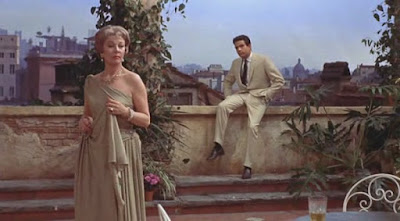
Vivien Leigh plays the title's rich, lonely widow, who loses herself to dissolute "drifting" in Rome. Beatty is her callow lover, a handsome Italian gigolo. Leigh was 48, her career ending; Beatty was half that and just starting. And look, that's Lotte Lenya as the cynical pimp renting Italian studs to rich widows. Lenya picked up an Academy Award nomination for the role, but we remember her now thanks to Bertolt Brecht and her pop-cult apex as Bond villain Rosa Klebb in From Russia with Love ('63).

Sounds like a fine combo platter, doesn't it? Well, in this case those ingredients got slapped together into a triple-decker crap sandwich.

The fat finger of blame first lands, plunk, right on the screenplay. It's credited mostly to Gavin Lambert, who in '65 adapted his own novel, Inside Daisy Clover, for Natalie Wood. Roman Spring's script delivers a far more golden pedigree, seeing as how it's adapted from Tennessee Williams' 1950 novella.

Yet it's such an excruciating bit of pulp, trite and bleary and interminable, clotted with dialogue that might read well in the dog-eared, yellowed paperback but just plops leaden onscreen. The prose is as purple as an eggplant, and the tone so overripe that the film often feels like a kitschy parody of Williams' florid excesses, or a worst-parts mashup of Williams and D.H. Lawrence. Starting with the thuddingly expository voice-over narration — Leigh's fading Broadway diva is "drifting, if not drowning, in a universe of turbulently rushing fluids and vapors" — what wants to be mature, sensual romance-novel boilerplate becomes instead a plodding exercise in intriguingly cast camp.

None of it is helped by wallowing in that charming puritanical leitmotif, sex = death. 

When the film gets talked about at all, which is hardly ever, the conversation tends to pin down whether we're seeing Leigh's own personal crises shaping and shading her tragically unhappy Karen Stone. Leigh's recently crumbled marriage to Laurence Olivier, and her history of debilitating depression coupled with a fear of failure, all appear to be there onscreen. Like Leigh, Karen is fiftyish yet still striking, a formerly revered actress obsessed by negative reviews in a young woman's profession, and is reacting to a marriage that has just come to a miserable stop. In Mrs. Stone's case, she seeks escape in Rome after her ailing husband, the inconsiderate lout, dies next to her on the plane while en route.


While seeking "light in the dark corners" of her life, she falls prey to Paolo (Beatty), who belongs to a stable managed by a vulturous Russian contessa in a crimson boudoir (Lenya, stealing her scenes by ladling up the Williams-speak like epigrammatic goulash). Lenya's madame and Beatty's gigolo have this arrangement, see: he uses his fluids and vapors to get the drifting, if not drowning rich American lady to lavish him with gifts of jewelry and trinkets. Then Paolo and his boss (who really would be more interesting with switchblade-daggers in her shoes) pawn the goods for cold, hard cash.

At first wary, and despite warnings from an old friend (Coral Browne), Karen ultimately embraces determined Paolo's appeal, and the pair become lovers. From there it's all hell and handbaskets, jealousy and neuroses, especially after a young American actress/twinkie (Jill St. John, just 20) also catches Paolo's opportunistic eye.

Leigh's rote performance wavers between on-the-money naturalness and a mannered archness that frequently puts quotation marks around her acting. Devoted Leigh fans tend to praise her "raw" or "brave" work here. While she is Vivien Leigh, which counts for something, that's just sentimentalizing her autopilot presence because of what she was experiencing in real life. (I guess I shouldn't be surprised — though I am — that there are Facebook fan pages for the film and "Karen Stone ∆ Vivien Liegh.")

More interesting is Warren Beatty. Not because he's better than Leigh, or even noticeably good. (His uncertain Italian accent may be the movie's only memorable element.) It's that today we can't help but watch Paolo through the lens of where Beatty would go with Splendor in the Grass, Bonnie and Clyde, and his own "gigolo" image. The scenes that Leigh and Beatty share are at least interesting in that regard.


During her scenes with them, Jill St. John is so insubstantial she hardly registers in the frame. In this DVD's featurette about the production, we learn that Leigh never spoke to St. John at all during filming.

The better behind-the-scenes story, though, involves Beatty (of course it does). The young actor was so hungry for an image-defying role that he borrowed money to visit Williams in Puerto Rico, bought a bottle of "man tan" and an Italian phrasebook, and ingratiated himself directly to the venerable author for the part, which had been putatively given to another actor. (According to IMDb.com, that may have been Terence Stamp or Oliver Reed.)

Beatty shouldn't have bothered. When the film opened, its overwhelmingly negative reviews — "an elaborately repulsive little picture," said Cue magazine, "a painful assault on love ... dialogue of suffocating archness," stabbed The New Yorker — were such a blow to Beatty that they nearly knocked him out of acting altogether. In his review, Bosley Crowther at The New York Times pointed to Beatty as "hopelessly out of his element as a patent-leather ladies man in Rome." Variety, in their cursory review, at least gave him a mixed positive: "Although every once in a while a little Guido Panzini creeps into his Italo dialect and Marlon Brando into his posture and expression, Beatty gives a fairly convincing characterization of the young, mercenary punk-gigolo."

Beatty was to later look back at that time and say, "I couldn't go on anymore. I couldn't face making another. Why? It's a question you'd need a treatise to answer. I was insecure. I'd lost the spark." (Source: Warren Beatty: A Private Man, by Suzanne Finstad.)

Roman Spring was the first feature film directed by José Quintero, a well-regarded theater director. (With Theodore Mann ten years earlier he co-founded the Circle in the Square Theatre in Greenwich Village, and had earned a reputation as the go-to director of Eugene O'Neill's dramas, notably the '56 production of The Iceman Cometh that launched Jason Robards.) Here, though, he appears incapable of injecting sufficient energy or charisma into the artifice and stagy prose, so we get a funereal lassitude almost by default.

Toward the positive, it's a well-dressed production, what with Harry Waxman's cinematography and travelogue shooting through Rome's bygone grandeur.


By the way, forget any modern enlightened ideas about Mrs. Stone's newfound widowhood and independence thrusting open a door to her own personal liberation and journey of self-discovery, sexual or otherwise. We're in 1961 here, remember, the Mad Men era except genuinely paleolithic. Flip either the genders or the ages of the two main characters and you get a profoundly different story, perhaps one assured of a "happy" ending.

Which takes us to the question of the mysterious shabby Young Man who constantly waits and watches Karen from beneath her balcony. Whether or not Quintero (or Williams) considered the Young Man to be her Death personified, Quintero sets up the final scene — broken and abandoned, she tosses her apartment keys down to him — in such a way that we're forgiven if we expect Rod Serling to stroll in from off-camera for the epilogue.


On the DVD, the 12-minute featurette, "Mrs. Stone: Looking for Love in All the Dark Corners," focuses on Leigh and Beatty in a perfunctory, tabloidy fashion, plus a few moments on some rather strained psycho-biographical parallels between Williams and his Karen Stone. Its talking-head material comes from Williams biographer Donald Spoto, Beatty biographer Suzanne Finstad, and Jill St. John. (Also included is that pompous, overwritten theatrical trailer.)


So, hey, happy birthday, Warren. I have Bonnie and Clyde and Shampoo topping the stack to watch next, along with a couple cocktails and the Roman Spring disc — pardon me while I push Eject — making an ideal coaster. Cheers.

Music: Josh Nelson, "Loose End"
Near at hand:  a blue crescent moon on a string
(Parts of this post originally appeared at DVDJournal.com.)