Showing posts with label Seattle. Show all posts

Saturday, February 4, 2012

The return of the return of the West Seattle Grouchos

The West Seattle Grouchos are a phenomenon I've posted about before.

To recap:

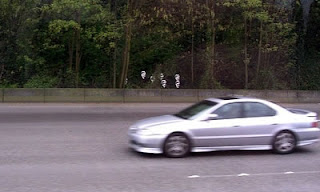
For three consecutive Aprils, 2007-2009, a curious sight popped up on my daily drive to and from my home. Soon after you'd hit the eastbound lane of the West Seattle Bridge connecting our neighborhood peninsula to mainland Seattle and downtown, and if you slowed down just enough to take a look into the woodsy area south of the bridge, there amidst the trees and the brush, you could spy — like a National Geographic photographer on a field assignment in wildest Freedonia — a guerrilla public art grouping of cutouts depicting Groucho Marx, each in full crouch as if foraging for wealthy widows among the greenery. (The spot is geo-marked at Wikimapia and wiki.worldflicks.)

But in 2010 they didn't show at all. We were left bereft of this anonymous urban art giggle-bombing. Where had they gone?


A year later, 2011 was shaping up to be another Groucho-less year. But then, as mysteriously as before, they re-appeared late in the summer. Hooray! Within a month or so they were gone again, slinking stealthily back to wherever they came from.

I've wondered when they'll show up again this year — or if they would at all. Today I was rewarded with an answer, and it came months earlier than expected. Plus, they've moved to a nearby spot more out in the open.

Two weeks after the big snow dump we now have blue skies and as far the senses can tell it might as well be April. Apparently the Grouchos think so too, because there they are, now off the westbound lane, integrated into the set of four bronze sculptures called "Walking on Logs."

"Walking on Logs" in its natural state.
I'm a fan of urban art, and "Walking on Logs" is a welcome adornment as you curve into the West Seattle gateway. It's not unusual to see the four bronze children outfitted with T-shirts or other accoutrements, usually promoting one cause or another. Lately they've been plugging the local Campfire Girls candy sale. And today I noticed that the unknown Marxists have struck again to lend a hand ... rather, a head. Five of them, in fact. To wit:


Clambering up the muddy hillside to take these shots, I'd never before been able to get this close to them. Only one was the full crouching figure, and it had blown over. As I set it upright again, I experienced the tingle of temptation to take it home and add it to my Movie Room decor. But the Harpo on my left shoulder yanked my ear something fierce. Besides, if I added one more Groucho Marx image up in our house Elizabeth would give me The Look. And who am I to deprive my fellow Seattleites of Rufus T. Firefly, Capt. Spaulding, Prof. Wagstaff, and Dr. Quackenbush?

"From the moment I opened your blog up until I closed it down, I was convulsed with laughter. Someday I intend reading it." — Groucho Marx (revised)


Related posts:

"It's a gala day for you!"

Eugene O'Neill with a Groucho chaser; or, Hello, I must be blogging

Happy Father's Day from Groucho Marx

Friday, January 20, 2012

Two by two

The big snow didn't last long. Right now, as I look out the living room window from this big comfy sofa, I can see that the ice is pretty much gone, the snow now just random patches. Elizabeth and I took Kai for a bayside walk and I swear he pined for the cold around his paws and the vistas that spoke straight to his Alaskan blood.

But it's nice to have it all back to Seattle Normal.

Still, I felt bad for the pair of yeti who rang our doorbell and asked if I’d be interested in their “literature.” They were so well mannered. I said no thank you, but sent them on their way with a shank of raw yak meat.


Thursday, January 19, 2012

Unsinkable

Credit: Aaron Brackney
Obviously, just because I'm still officially on "Intermission" that doesn't mean I won't pop in here now and then to stoke the fire a bit. Still TBD is whether this portends an expansion of this blog from "mostly movies" to "more or less movies mostly, yeah, but also more of the other stuff too depending on my own caprice and whims."

If you've kept up with the U.S. news this week, you know two things: (1) Newt Gingrich is still to "values" what a ten-gallon sack of live tapeworms is to a recipe for Lobster Thermidor, and (2) Seattle got socked with more snow in two days than we usually get in a year.

Although Elizabeth and I were effectively immobilized here atop the crest of our West Seattle ridge surrounded by hills worthy of a Jamaican bobsled team, we were well provisioned and experienced no significant difficulties.

Well, there was that one thing:

Wednesday's fine blanketing of new-fallen snow has by now become, after hours of light freezing rain, that afternoon's solid encasement in ice. So today I spent some quality muscle-time chipping and shoveling a mountain of ice off our front steps.

Just as I was wearily leaning the shovel near the front door, an enormous passenger liner hove into view, moving at top speed. It struck my mountain of shoveled ice, capsized, and broke in two. The scream of wrenched metal! The shrieks and lamentations of tumbling bodies! Down, down it slid with eerie grace into the snow near where Kai peed on a bush just a few hours earlier. And yet the band played on. A pitiful few lifeboats, some only half full of wailing women and children, managed to break away and row down 41st Ave. toward the more traveled depths of Andover Street and possible rescue. The last thing I saw was Leonardo DiCaprio sinking into the lawn. I would have offered him a rope or the shovel handle or something, but just then, from the kitchen, I heard the kettle for the hot chocolate. I feel kind of bad about that, but, after all, needs must.

Now, although I didn't have the expected difficulty of getting my car started, I still gotta hire somebody to clean up the lawn by hauling away all those deck chairs.

Wednesday, January 18, 2012

An Alaskan Malamute in Seattle (part 2)

Soon after his atavistic explorations of the Iditarod-worthy front yard, Kai checked out the back to see how it compared.


Yep. About the same.

And yet, there's always a downside:
Definitely not ham.


"Wimpy furless primates. You want to go back indoors already?"

Oh, one last thing: When dog-walking out in this kind of cold, DO NOT accept a "double-dog dare" to put your tongue on your pooch's nose. Trust me on this one.


An Alaskan Malamute in Seattle (part 1)

Of course there are inconveniences that arrive with any massive dump of snow so large that the nearby Starbucks corporate HQ officially approves two new seasonal coffee beverages: the Shackleton (a low-low-fat white mocha that never makes it back to your home) and the Donner Party Half-Calf (tastes like chicken). But there was one member of our household who loved the whole experience down to his DNA: our dog Kai.

In his cool equanimity, he proved that this was no "Snowpocalypse," no "Snowmaggedon." In fact, I hope that both examples of lingua hysterica will now be banished from the Tiresome Media Freakout lexicon.


After all...
... it's just snow.

Still pretty damn cold, though.


On the other hand...
... the neighborhood kids are out playing.
And that short beefy child looks a lot like Jack London.

Tuesday, August 2, 2011

The return of the West Seattle woodland Grouchos

Via matthetube's Flickr. Thanks, Matt.
Last year in a post titled "Where Are the West Seattle Grouchos?" I lamented the mysterious absence of an urban guerrilla art giggle-bombing that, from 2007-2009, had manifested annually in a stretch of woods alongside a major thoroughfare near my neighborhood. They were the West Seattle Grouchos, and they never failed to lift my spirits as I drove past. Yet last year these drive-by non sequiturs didn't reappear, so I missed the whimsy that seemed aimed at me, a dedicated Grouchophile, on my daily drive into downtown Seattle.

Did the herd of crouching Grouchos migrate to greener Freedonias? Had the unknown artiste(s) moved on to bigger things — perhaps San Francisco and giant Harpos on the Golden Gate Bridge? If so, I wished that I could thank him, her, or them, and perhaps buy a round of a local ale followed by a showing of, say, Duck Soup on the big screen at my house. But alas, they'd vanished like Zeppo at MGM and to all appearances the era of the West Seattle Grouchos was over. (The spot is geo-marked at Wikimapia and wiki.worldflicks.)

So I'm pleased to report that they're back again. And they've multiplied. They're in the same location as before, although given the long, wet spring and nominal summer we've had this year, the underbrush is even more jungle-like than before and the Grouchos aren't quite as easy to spot. So, armed with a camera, yesterday I pulled off to the shoulder of the road and snapped this new herd in the wild before they vanish again for who knows how long.


Tuesday, March 29, 2011

Revelation found in an attic — Seattle's Admiral Theatre, 1-23-42

From last night's West Seattle Blog, my top source for all things within walking distance.


From the blog entry:

Heike shared that Admiral Theater ad from the January 23, 1942, “Seattle Daily Times.” We asked how the old paper was found. Reply: “We put a few can lights into the ceiling, and had to go up into the attic for rewiring. Pretty amazing that it’s been there all this time!”

The "Inaugural Program" feature: Weekend in Havana with Alice Faye, Carmen Miranda, John Payne, and Cesar Romero (also Sheldon Leonard as "Boris"). Admission was 30¢, children 10¢ "(plus tax)." I'd love to know what the selected shorts were.

Moviegoers stepping out on that cold Seattle night to catch Carmen Miranda's fruit hat might have chosen it over Woman of the Year, starring Spencer Tracy and Katharine Hepburn, which opened four days earlier. Also released that January were The Man Who Came to Dinner (starring Monty Woolley, Bette Davis, and Ann Sheridan) and Lady for a Night (John Wayne, Joan Blondell; not one of either star's better titles). 

Johnny Eager with Robert Taylor and Lana Turner premiered in L.A. in December, then opened wide January 17. Similarly, the great Preston Sturges' great Sullivan's Travels saw its official release in December, though its New York City premiere didn't occur until January 28.

January 29 marked the release of Son of Fury: The Story of Benjamin Blake, starring Tyrone Power, Gene Tierney, George Sanders, and Frances Farmer, the self-described "freak from West Seattle High" who once lived just a few blocks from the Admiral Theatre site.

Disney's Fantasia, from 1940, was back in wide release again. King's Row (Ann Sheridan, Robert Cummings, Ronald Reagan) was just ten days away.

Probably still playing locally were such December releases as The Wolf Man with Lon Chaney, the musical Hellzapoppin', and Tarzan's Secret Treasure, the fifth in the series to star Johnny Weissmuller and Maureen O'Sullivan. They Died with Their Boots On (Errol Flynn and Olivia de Havilland) had been around since November, though since it became 1941's second-highest grossing film after Sergeant York, it must have been still packing them in through that January.

John Huston's The Maltese Falcon, starring Humphrey Bogart and Mary Astor (of course), had been on screens less than four months, and Citizen Kane was just eight months old.

In January '42 Casablanca was in an early production phase to premiere the following November. (Shooting began on May 25 and was completed on August 3.) Also in various stages of production at the time were Alfred Hitchcock's Saboteur, which premiered in April, as did Jungle Book with Sabu; Tortilla Flat (Spencer Tracy, Hedy Lamarr, John Garfield) in May; come June film buffs got both Mrs. Miniver (1942's box office champ and Best Picture Oscar) and Yankee Doodle Dandy (Cagney's Best Actor Oscar), followed in July by Orson Welles' The Magnificent Ambersons (sort of) and Pride of the Yankees with Gary Cooper and Babe Ruth.

Bambi opened in August alongside Holiday Inn with Bing Crosby and Fred Astaire. Finally in December the Admiral could screen the Val Lewton/Jacques Tourneur Cat People and Ernst Lubitsch's To Be or Not to Be, the last film to star Carole Lombard, who was among those killed in a plane crash near Las Vegas on January 16.

Moviegoers on that January 23 probably extra-appreciated Weekend in Havana's bubbly nonsense six weeks after the Pearl Harbor bombing. Three days after this ad ran, on January 26, the first American forces arrived in Europe, landing in Northern Ireland.

Now a second-run house, the Admiral is still there, just a mile from where I'm sitting. Its ongoing existence — 70 years next January, apparently — has been precarious at times, so it's always a pleasure to walk in and catch the vintage vibe that remains of "Seattle's Newest Theatre."


Music: Carmen McRae & Betty Carter, Duets: Live
Near at hand: A faceted glass heart, chipped, found at our front yard entrance gate. Curious.

Monday, March 21, 2011

Of lighthouses and foghorns and beasts from evocative fathoms

I live within walking distance of a lighthouse (Google Maps). Okay, it's not a casual walk like a stroll to a neighborhood coffee shop as an excuse to procrastinate stretch my legs after hours here in this chair. But it's a doable walk when the mood strikes to shut down this laptop and head out for an afternoon outside these four walls.


At 98 years old, it's a working Coast Guard lighthouse, one that's open to the public only a few weekends each summer. As far as picturesque lighthouses go, it's a modest structure, but as a walking destination nearby it beats the colossal hole in the ground where the Whole Foods was supposed to go three years ago.

Any lighthouse is inherently romantic. Perhaps especially during the lingering gray of a Seattle winter, such as the one that ended (officially) yesterday.


From my home office window, I can hear the foghorn, invariably evoking images of a lonely sea creature rising from Puget Sound to seek the source of the baleful call and hump woo it.

Which brings to mind, every time, the forlorn and frustrated creature from Ray Bradbury's Saturday Evening Post story "The Foghorn," and particularly its atmospheric visualization in Ray Harryhausen's seminal The Beast from 20,000 Fathoms.


This enjoyable "B" popcorn cruncher from 1953 is noteworthy not just for establishing a template for the Atomic Age Behemoth flicks that followed. Its giant dinosaur was the first solo project by upcoming stop-motion talent Harryhausen, a protégé of Willis O'Brien of King Kong fame. For the first time, Beast allowed Harryhausen complete special-effects control of a feature-length film.

It opens in the white Arctic wastes, where a nuclear bomb test rouses a "rhedosaurus," an immense dinosaur suspended in the ice for a hundred million years. Driven by its primitive instincts, the giant reptile heads for its ancient breeding grounds — which are now occupied by New York City. The ensuing Wall Street walloping remains archetypal (and, lately, extra soul-satisfying), with automobiles crushed beneath reptilian claws and policemen gobbled like Jell-O shots.


After military bazookas only wound it, the stricken brute makes its climactic last stand at the Coney Island rollercoaster. There marksman Lee Van Cleef and scientist Paul Hubschmid (billed as Paul Christian) aim for the soft spot with a grenade spiked with radioactive isotopes. (A well-timed all-consuming conflagration helps too.) Every great monster movie needs a kindly professor, and that service is ably provided by Cecil Kellaway, the only standout among the cast until he's swallowed whole in his bathysphere. Genre fans will recognize The Thing From Another World's Kenneth Tobey as Col. Jack Evans.


Lacking the personality of O'Brien's Kong or Harryhausen's later creations, the rhedosaurus is just a big dumb animal eliciting little sympathy from the audience. But it's true that Harryhausen monsters die like operatic tenors, and it's a tradition that begins here.

Harryhausen and production designer-turned-director Eugene Lourie made Beast independently as a private project for $200,000. Warner Brothers then snapped it up for a song compared to the millions it raked in for the studio. Because Beast was one of 1953's biggest box-office successes, a new subgenre was born, showcasing irradiated and/or gigantized reptiles, ants, spiders, crabs, bugs, scorpions, leeches, lieutenant colonels, and Allison Hayes. It also proved that quickly-made, inexpensive monster movies could be profitable even if all the stuff surrounding the special-effects scenes (e.g., the acting of purest knotty pine, a suspiciously stagebound "Arctic," the slow and tin-ear script) failed to rise to the level of Harryhausen's tabletop creations.

After Beast, Harryhausen signed on to do it again for It Came From Beneath the Sea ('55), which substituted the rampaging rhedosaurus with an enormous radioactive octopus.

The Beast From 20,000 Fathoms is slow and stodgy today, and its comparatively primitive visuals are impressive more for their pioneering history than their technical polish. That said, the opening twilight lighthouse scene and the closing Coney Island assault remain moody mile-markers in effective genre cinema.

As far as I know, the Alki Point Light Station has not yet been ravaged by a passionate saurian from the Mesozoic. Nonetheless, I often recall that poor beast when I see our local lighthouse, especially on those gunmetal-and-charcoal overcast days when nature gets as close as it ever does to vintage black-and-white.


Music: Sharon Isbin
Near at hand: Duck Dodgers figure

Thursday, October 21, 2010

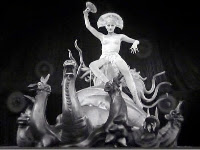
"Metropolis" with the Alloy Orchestra live

This evening, Elizabeth and I are catching Fritz Lang's 1927 science-fiction epic Metropolis, newly restored from recently discovered elements, at the Seattle International Film Festival Cinema.


That's cool enough all by itself, but what makes this presentation even better is that the film will receive its musical scoring performed live by the Alloy Orchestra.

My favorite "silent movies music" combo for years, the Alloy Orchestra are the most eclectic and eccentric — and brilliant — film re-scorers working. This Boston-based trio possesses the uncanny ability to be hip, odd, clever, raucous, delicate, or playful while simultaneously showing respect and affection for the films we're watching. Their nontraditional percussive, quirky orchestrations are action- and scene-tailored while avoiding the temptations of "old-timey" clichés or "postmodern" avant-garde ambiguities. Their scores are fresh and thoroughly modern but aren't likely to ever feel frozen into a definable "now."


With their newfangled approaches to vintage movie scoring, the Alloy Orchestra can be an acquired taste. Some traditionalists don't care for their distinctive innovations. Others — yours truly, for one — acquired the taste in the first bite. In my case, that was David Shepard's restoration of The Lost World, followed soon by the Image Entertainment DVD editions of Buster Keaton's The General / Steamboat Bill, Jr., and Slapstick Masters. They've been doing this sort of thing for a while: in 1999 Entertainment Weekly listed them among "The 100 Most Creative People in Entertainment."

Think of them as, perhaps, They Might Be Silents.

The Alloy Orchestra's Metropolis soundtrack is available (MP3-CD format) via their website. It will sync up with the Kino DVD and Blu-Ray release of the film (see below).


Oct. 22 Edited to add post-viewing thoughts:

The SRO crowd gave the movie and the Alloy Orchestra an extended standing ovation. Well deserved too. The new score was electric and note perfect. 

As for this edition of the movie itself, its narrative tracks much more smoothly now. Old gaps in sequence and plot logic are (for the most part) sewn up, and the nefarious character of the Thin Man (not William Powell) finally has a sense of purpose (and that actor is a real standout in a film full of interesting faces). Also clarified is the backstory between Joh Fredersen and the necromage Rotwang, how their rivalrous love for the lost Hel feeds Rotwang's scheme to create the Maschinenmensch and take from Fredersen everything he believes in. Best of all, this time I came to really appreciate how terrific an actress Brigitte Helm (age 17-18 during filming!) was in the dual roles of Maria and the faux-Maria robotrix.

I've always found Metropolis to be more impressive cinematically and historically than narratively, a stance that probably doesn't make me some radically contrarian outlier. It's visually stunning, of course, like no other film of its era, and this new restoration bolsters that even more so. Yet for me its visual and social metaphors are as subtle as an undergrad paper on Poetic Symbolism, and that grates. The plot's reductive simplicities — previously heightened by the gaps in logic and structure that
this edition mostly remedies — have always been speed bumps on my path toward fully embracing the film's singular awesomeness on an emotional level. With this newly refurbished edition of the film some of those bumps still remain, but they hardly matter. Mere molehills. I recommend this Complete Metropolis with a hearty Oh hell yeah.

Kino International's Complete Metropolis Restoration site.

May 4, 2010 NYT article on the restoration.

Roger Ebert's review of the 2010 restoration is here.

David Bordwell serves up plenty of fine analysis and background leading to this restoration here.


And most exhaustively, the International Federation of Film Critics' webzine Undercurrent posts Metropolis Found, a comprehensive history of the movie in all its tangled iterations, focusing on the game-changing near-complete print, uncovered in Argentina, that provided this restoration. It's by Fernando Martin Peña, excerpted from his book Metrópolis.


In related news, Kino International has announced the Nov. 16 release of on DVD and Blu-ray. According to Kino's press page, this edition will finally let us bring home the film...
...with 25 minutes of previously lost footage and the original Gottfried Huppertz score. Only six minutes short of the film Fritz Lang premiered in January of 1927 (in Berlin), THE COMPLETE METROPOLIS was made possible due to an essentially complete 16mm dupe negative (struck decades ago, from a now-destroyed nitrate print) discovered by the curator of the Buenos Aires Museo del Cine in 2008.

Such a rare discovery demanded another restoration of this classic film, and the Murnau Stiftung (Foundation), under the supervision of Film Restorer Anke Wilkening, embraced the challenge of putting together the most historically accurate version of this German masterpiece.  Also returning was Martin Koerber, Film Department Curator of the Deutsche Kinimathek, who had supervised the 2001 restoration.

As special features, THE COMPLETE METROPOLIS makes available (both on DVD and Blu-ray) a never-before-seen 50-minute documentary on the making and restoration of Metropolis - as well as an interview with Paula Felix-Didier, curator of the Museo del Cine, in Buenos Aires, and the Trailer to the 2010 restoration. This new 147-minute version (being released as THE COMPLETE METROPOLIS), opened theatrically in April of 2010 and has broken box office records in many of the 100-plus markets it has played in.

This Blu-ray hits the shelves two days before Elizabeth's birthday, and I love, love, love the fact that I'm married to a woman who, immediately after viewing that trailer up there, let me know what her present should be. She blogs about the movie here. (I loved typing that.)

Tuesday, October 19, 2010

Thursday, October 14, 2010

It's a Vertigo kind of day


...although it's not because I'm feeling unbalanced. Well, no more than usual anyway.

Elizabeth was in the mood for some Hitchcock recently. So I connected this Macbook to the big screen and, voila!, via Netflix steaming we watched Strangers on a Train. Chances are good that The 39 Steps will be next in line.

Since then, ol' Alfred has been popping up on my day-to-day radar with unnerving frequency. Last weekend Seattle's SIFF Cinema featured a Hitchcock series. Our friend Wendy emailed to ask if we might be in Portland for Halloween, in which case we could catch Psycho screened with Bernard Herrmann's signature score performed live with the Oregon Symphony. My big blog post on the near-miss of a Hitchcock version of The War of the Worlds drove email into my Inbox as recently as this morning. Meanwhile, downstairs in our movie room, the North by Northwest poster framed above the shelves urges me to slide that Blu-ray disc into the player again. Or else Rear Window, my other Hitch fave.

And now, mere minutes ago, Elizabeth sends me email stating that our upcoming trip to San Francisco (where my stepson Austin rocks grad school, and where we have friends and relatives) will include reservations at Hotel Vertigo...
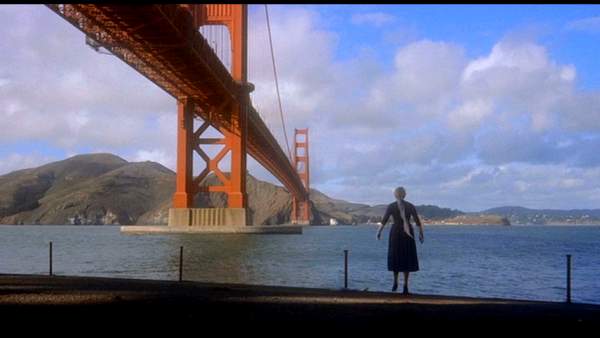
... a newly-opened homage to Hitchcock in San Francisco. It's been 50 years since Hitchcock's thriller of the same name was released (some scenes were filmed in the original hotel that occupied this building); to mark the occasion, the movie will be projected onto the floor of the lobby, and screened in the rooms 24 hours a day. Madeleine cookies (named after Kim Novak's character) are dished out to guests on arrival, and bedrooms will be decked out in a giddy white-and-tangerine combo. Hitchcock obsessives should book into Suite 13, where they can spend sleepless nights hunting for the 13 references to the film.
Maybe we'll take the Vertigo Movie Tour of San Francisco. The fact that a movie buff can make such a pilgrimage amuses me amply.


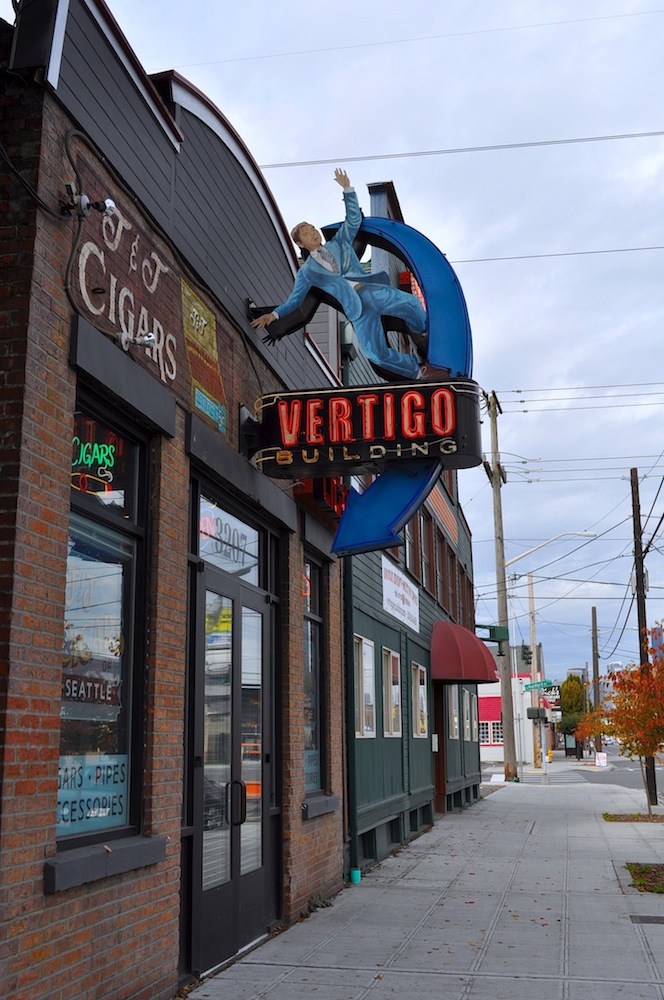
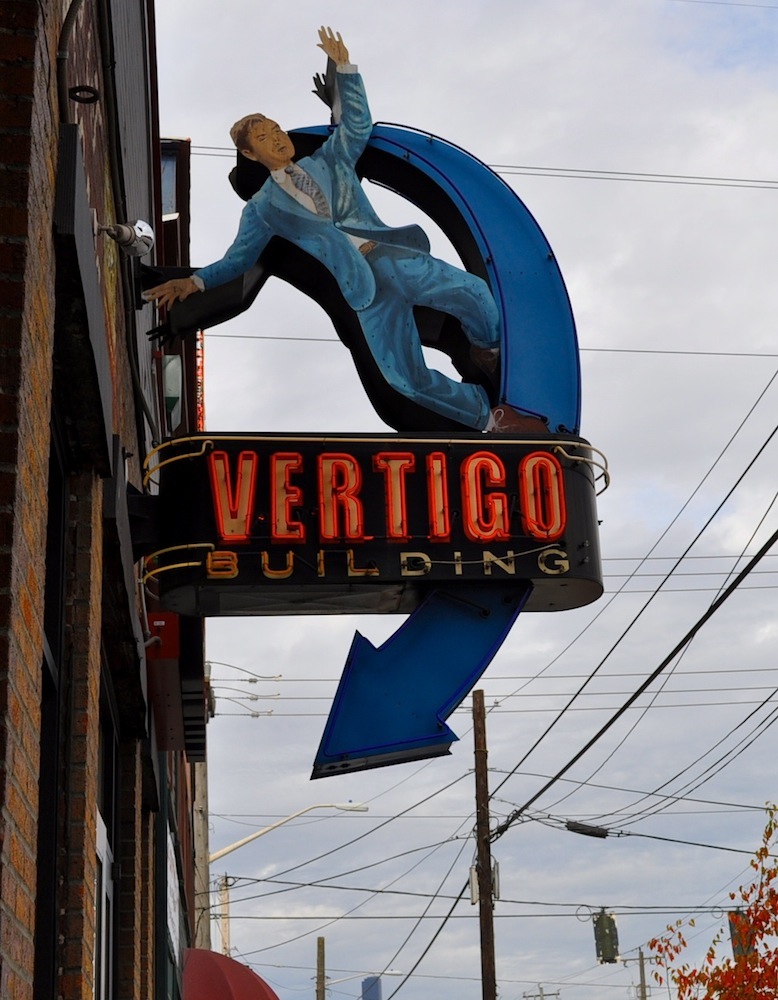
And finally, just a few hours ago I spied my most frequent Hitchcock reminder. It's exactly three miles from our house, on the other side of the West Seattle Bridge (once home to the mysterious Grouchos). It's an example of vintage neon signage that I pass routinely on my way into downtown Seattle.


That's the Vertigo Building on 1st Avenue South. The sign is indeed an image of Jimmy Stewart as "Scottie" Ferguson in Vertigo.


Although you'd be forgiven for thinking of North by Northwest:


I've seen businesses come and go there over the past five years. Earlier this year the building was empty and up for lease, so I feared that its odd and magnificent sign would soon end up either in a trash dump or on eBay. Yet this summer J&J Cigars moved in, and cigar aficionados may now gather together in the second-floor Vertigo Club. I'll gladly take that as a clue that the sign is staying.

Naturally, there's an obvious question you've already asked. What the hell's up with that sign? Where did it come from?

A little googling turns up a Seattle Times neighborhood profile from 2003. The building is owned by Dr. Scott Andrews, a dentist and developer who "imprinted his personality, hobbies and memories" on this section of the largely industrial neighborhood. The Vertigo sign is the last remaining item of Dr. Andrews' street nostalgia. The attached building next door once displayed three leaping cutouts of old-time baseball players, and a 1950s-vintage Superman hung in mid-flight on a building across the street. Those are gone now, alas. According to the Times piece,
Andrews still practices dentistry, but keeps an office in the building. He pushes a bookcase door to reveal his private theater, with eight double-wide leather seats. His party room on the same floor is adorned with movie posters and worn stadium seats, representing old Sicks Stadium. Soon, he hopes to have an old-time hotdog stand on a nearby street corner.
"Everything here relates in some way to my childhood," Andrews explains.
I wonder if he's still practicing seven years later?

Here's hoping this recent The Birds-like clustering of random Hitchockiana around me peters out soon. Not that I don't dig Hitch, mind you. It's just that any day now I expect him to start making cameo appearances in my life: