Showing posts with label 1958. Show all posts

Wednesday, March 23, 2011

Cat on a Hot Tin Roof (1958) — Mint julips and hot slips

Elizabeth Taylor died today. The obits and appreciations and tributes everywhere tell us that she was 79. But that suggests there was an earlier time, an epoch, a state of existence that predated Elizabeth Taylor. Was there ever such a time, really? From where I sit, there has always been *Elizabeth Taylor* in tall type and a photo three columns wide.

As an actress gifted, apparently, starting in the womb — then later as a persona, a pop-cult presence, a totemic "violet eyes to die for" emblem of a particular Hollywood era and glamor — eight times out of ten she was more interesting than the movie she was in. Out of her fifty films, maybe a half-dozen remain easily retrievable from the extempore cultural memory. (How many people today acknowledge her more for her eminent AIDS charity activism?) And yet no matter how hard a script or director tried to lock the tractor beams of camp onto her (a case in point), somehow she resisted the pull, even if only by inches. Her bold, liberating, Oscar-winning Martha in Who's Afraid of Virginia Woolf, Mike Nichols' debut film from Edward Albee's play, is the performance that will long stand as testimony to her being, at her screen best, a presence beyond *Elizabeth Taylor* in sequin lights and the staccato of paparazzi flashes.

As usual, I'm compelled to reach to the discs on my shelves and restore her for a while. Here's the first movie I ever saw her in. It's not one of my favorites, honestly, but she left an impression.


Among the sweatiest of Tennessee Williams' southern character studies, Cat on a Hot Tin Roof in 1955 gave Broadway an iconic sizzler in provocative Maggie "the Cat," a passionate, determined young wife with a smoldering case of the sexual fantods. In 1958, the inevitable Hollywood adaptation forged an equally iconic screen image in Elizabeth Taylor's Maggie, her body heat barely contained within a clinging white slip. No retrospective montage of Taylor's career is without it, and today the sight of her is still one to give us the vapors. She was 26 years old, in her 26th film.

(This isn't the earliest point in her career at which Taylor causes me to fan my collar. That would be A Place in the Sun with Montgomery Clift from 1951. Then there's MGM's "knights in shining amour" storybook epic Ivanhoe from '52. While Joan Fontaine was one of MGM's marquee beauties, she must have rued the day that Ivanhoe's other damsel went to Taylor, then only 20, who steals Fontaine's thunder with her eyes alone.)

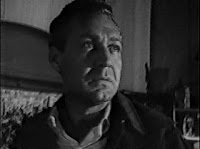
As her alcoholic, broody, and cripplingly repressed husband Brick Pollitt, Paul Newman's was a make-or-break performance. The artless Production Code watered the gin of this Pulitzer-winning play's translation from stage to screen, in particular the play's implication that what haunts Brick are memories of a homosexual relationship with his lamented dead friend "Skipper." Although that significant layering got cut down to nothing — well, almost nothing — the role of the self-loathing, aging football hero broken by his best friend's suicide gave rising star Newman (MGM's "new Brando") a prestige-picture opportunity that springboarded his career to its later signature peaks.

Together Taylor and Newman's intimate scenes, which amp up tension out of Maggie and Brick's paralytic lack of intimacy, are the emotional wheels of a film that's simultaneously gunning its engine on a tempestuous reunion at the Pollitt plantation mansion.

This gathering of the dysfunctionals is ostensibly a 65th birthday celebration for the family's patriarch tycoon, Big Daddy. Played with image-defying bearishness by Burl Ives, Big Daddy is an obese, cancer-stricken Mississippi Lear, raging at the lies and "mendacity" polluting his materially wealthy, but emotionally and spiritually impoverished, world.


The grasping, gold-digging fawners surrounding Big Daddy and vying for his fortune include Brick's conniving older brother Gooper (Jack Carson) and Gooper's grotesque, perpetually pregnant wife Mae (Madeleine Sherwood), whose five "no-neck monsters" are such odious children they may have turned the entire Mississippi Delta on to birth control. Australian Judith Anderson (later Dame Judith) impresses in a second against-type role as fluttery, spiteful "Big Mama" Ida. A now clichéd literary Old South incarnate, here's a family trapped in its social network of deception, greed, hypocrisy, and denial, where "liquor and death do remain the only exits" — in other words, 180-proof Tennessee Williams.


Williams — born one hundred years ago this Saturday, by the way — was one of America's foundational dramatists. This production's bowdlerized adaptation of the stage play diminishes his raw sensitivity and plugs in some safe triteness about the value of family over material possessions. And the play's core topical hot spots — definitions of manhood, acknowledged female sexuality, Brick's own hidden sexuality — are hardly flashpoint material anymore. Still, this over-scrubbed production kept enough of Williams' energy and poetic Americana intact, fleshing it up with an ensemble of career-imprinting performances and MGM production lavishness.

Despite a few dips into obviousness and (unavoidable) melodrama, the film's pacing and drive remain steadily under the assertive, discerning control of tough-guy director Richard Brooks (Blackboard Jungle, Elmer Gantry, In Cold Blood, and 1962's Newman-Williams Broadway adaptation, Sweet Bird of Youth). Brooks also adapted the script with James Poe, and, despite an apparent lack of interest in Southern verisimilitude, did a seamless job "opening up" Williams' single-set play.

The film's Academy Award nominations went to Taylor, Newman, and Brooks, also Best Picture, Cinematography, Color, and Screenplay Based on Material from Another Medium. (Alongside the film's name-brand star power, the art direction and the cinematography by distinguished cameraman William H. Daniels really are first-rate all the way.) None won, and it's an inexcusable Academy gutterball that Ives wasn't even nominated. All the same, this was MGM's top box-office hit of the year.

Two years later, Taylor finally won her first Academy Award for Butterfield 8. It was a film she hated, but there she is in a slip again, and I can't say it doesn't work for her.


Music: Frank Zappa, Broadway the Hard Way
Near at hand: SFWA 2011 election ballot

Monday, April 12, 2010

The Crawling Eye (1958) — Set LASIK blasters on "poke"

Occasioned solely by my realization that I need to get my contact lenses Rx updated:

"Giant, tentacled eyeballs from outer space use their alien powers to reanimate corpses and send zombies to murder telepathic earthlings!"

With PR like that, what's not to love? For aficionados of old, low-budget genre movies grades B-through-Z, the DVD age is a godsend. Studios are releasing their dusty-basement back-catalog items, and often in no-frills, priced-to-sell editions that give fans and collectors guilty pleasures and fodder for deep-geek analysis. Sometimes gold can indeed be found in creaky sci-fi or horror, um, "classics." Other times ... well, a bad movie can have its charms and still be acknowledged as a bad movie. The U.K.'s The Crawling Eye (1958) is a bad movie — but it's the good kind of bad, with not a mean-spirited bone in its gelatinous, pimple-shaped, tentacled, one-eyed body.

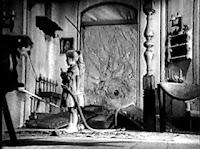
On an Alpine mountain under a mysterious radioactive cloud hide a squad of ill-tempered invaders from outer space, bulbous blinkers anticipating The Simpsons' Kang and Kodos.


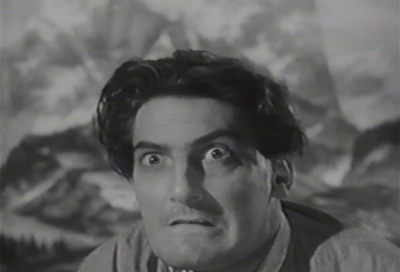
They exert telepathic influence over some local humans, notably a pair of mind-reading sisters (Jennifer Jayne and the lovely, well-chosen Janet Munro). Before long, with headless corpses and mind-controlled killer zombies entering the mix like downmarket H.P. Lovecraft, an American investigator (genre go-to hero Forrest Tucker), who's haunted by memories of a similar event that "happened in the Andes," is on the case right up through the climactic siege battle between the humans and the aliens.

(For added entertainment, make a drinking game out of every time a character in the movie has a drink. You may not make it to the final battle at all.)

The Crawling Eye moves through its 84 minutes at a fair clip, often with mood and atmosphere. While the script offers not a single deliberate joke or moment of witty repartee to add even a dash of pith, the movie's straight-faced earnestness, especially when Kang and Kodos show up, is pretty funny all by itself.


The special effects — backdrops, model work, miniatures, the whole Swiss cheese assortment — never really succeed at providing meaning to either "special" or "effects," although when the titular monsters finally reveal themselves, a happier use of papier-mâché cabbage heads can't be found this side of Invasion of the Saucer Men (1957). Meanwhile, crisp DVD resolution reveals the wires moving the tentacles about.

Jimmy Sangster, one of England's best postwar horror film writers (Revenge of Frankenstein and other Hammers), adapted this screenplay from a 1956 BBC TV serial called The Trollenberg Terror. Like Britain's Fiend Without a Face (also from '58), this is silly, formulaic stuff, in black-and-white, but well-brought-up kids and sincere grown-up appreciators of vintage low-budget genre cinema will find plenty to enjoy here.

Stephen King, in his 1986 novel It, includes a scene with The Crawling Eye showing on TV. Later in the story, the novel's eponymous pandimensional horror manifests briefly as a Crawling Eye.


Image Entertainment's DVD release of The Crawling Eye is nothing less than the original "Widescreen European Edition" that debuted in England as The Trollenberg Terror in 1958 with an "X" rating certificate — a significant improvement over prints shown on television over the decades. The transfer used an original source print supplied by the British Film Institute, so it looks great, and its monaural audio track sounds fine.

Within a fold-out insert, two pages of production notes are appropriately respectful.


Naturally, this is the sort of movie that stands on a corner with a hand-made sign reading, "Plese give me the Mystery Science Theater 3000 treatment -- anything helps." So here it is in MST3K's 101st ep, back when Joel was still on board the Satellite of Love:


Music: Modest Mouse, "Little Hotel"
Near at hand: Empty plate that moments ago held a sliced orange. Yum.