Showing posts with label 1967. Show all posts

Sunday, September 4, 2011

Bedazzled (1967) — Giving the devil his due

In a couple of weeks Elizabeth and I will be in London. The circumstances behind the trip caught us by surprise. We weren't planning to go to London until, well, things happened and suddenly we had tickets on British Air. (Portland, New York, and San Francisco are now also on our pleasure/business calendar between now and November. Elizabeth is jetting off to L.A. tomorrow evening. It's a whirlwind, I tell you.)

As I mentioned here, on our itinerary is the current production of Dr. Faustus at Shakespeare's Globe. Of course, me being the guy I am, that guaranteed that I'd reach to the DVD shelves to pull out another British take on the Faust legend: Bedazzled from 1967. This cheeky comedy infused the centuries-old story with the spirit of Swinging London plus impudent pokes at religion, politics, and pop culture itself.


Any conversation about the so-called British Invasion of the 1960s tends to focus on the new pop and rock music that tsunamied over American popular culture mid-decade. But riding that wave also came new styles of envelope-pushing comedy.

This brash, cocksure postwar generation of young Oxbridge-educated comics modernized the British tradition of satire with sharp verbal wit, straight-faced or absurdist approaches to outrageous material, and gimlet-eyed sarcasm toward the previous generation's institutions. Political figures, religion, the upper classes, "high" and "low" culture/society/art — all were now open targets for unapologetic lampooning.

In the early '60s, Peter Cook and Dudley Moore, with Jonathan Miller and Alan Bennett, led this New Wave satire movement in Beyond the Fringe, a stage revue that began at the Edinburgh Festival and then went on to acclaim in London and on Broadway. Cook and Moore furthered their comedy partnership — "Pete and Dud" — on British television, most notably in their hit BBC series Not Only...But Also.

With this success in their pockets, they pitched a film to Twentieth Century Fox, a mod spin on the Faust legend, with Moore as the woebegon schmuck who sells his soul to Peter Cook's dry, wry horned one.

As luck would have it, they already had an enthusiastic fan in director Stanley Donen, whose creds included Charade and Two for the Road, as well as top-drawer movie musicals in the 1950s: On the Town, Funny Face, and Singin' in the Rain. Donen asked to work with Cook and Moore, and in 1967 — the year of Sgt. Pepper and The Who smashing their kit at Monterey — the duo's best film, Bedazzled, opened their distinctive brand of humor to new audiences, with hopes toward going really big in the huge new U.S. market.


As timid, tongue-tied Wimpy's short-order cook Stanley Moon (a role that leaves me aching that he never co-starred with Rowan Atkinson), Moore pines for an aloof waitress, Margaret Spencer, played by veteran comic actor Eleanor Bron. So unrequited is his love and so deep his anguish that this hapless hash-slinger opts to hang himself from his tiny flat's water pipe. His goodbye note leaves Margaret his collection of moths.


He fails at that too, of course, although he does attract the attention of Mr. George Spiggot (Cook), a dapper swell who knows more about Stanley than anyone else cares to. Spiggot reveals himself to be none other than the Unholy One, evil incarnate himself.
Stanley: "I thought you were called Lucifer."
George: "I know. 'The Bringer of the Light' it used to be. Sounded a bit poofy to me."

It turns out that rather than sitting on a throne of skulls in his fiery infernal kingdom, the devil makes his God-appointed, workaday living as the proprietor of a grubby London nightclub and business office staffed by the Seven Deadly Sins. "What terrible sins I have working for me," he says of the riffraff Anger, Sloth, etc. "I suppose it's the wages."

He offers Stanley seven wishes in exchange for the miserable little soul that, he says, is no more useful than Stanley's appendix. The appeal is irresistible to desperate Stanley: a chance to remake himself in any way imaginable to win Margaret's heart (as well as, naturally, her other bits).


Thus begins, with the magic incantation "Julie Andrews!", an episodic series of altered-reality shaggy-god scenarios that place Stanley in situations of his choosing — as an intellectual aesthete, a millionaire already married to "highly physical" Margaret, a pop star with Margaret among the hoard of groupies, a fly on the wall (endearingly cartooned), and so on.


The Devil, though, can't resist the opportunities to insert himself into Stanley's wishes and screw them up. After all, it's in his job description. It's the old "Be careful what you wish for" angle, with the wording of Stanley's wishes interpreted with all the fiendish legal exactitude of an iTunes Terms & Conditions form.


Cook's deadpan skewering of fleeting pop-idol vanities will never lose its currency. "I'm callous … I'm dull … You bore me ... You fill me with inertia," he monotones as Drimble Wedge & the Vegetations, upstaging and out-groupie-ing Moore's Tom Jones–esque soul-cry, "Love Me!"

The silliest/funniest sequence arrives when exasperated Stanley wishes to be with Margaret in a place of peace and spiritual purity: there he and Margaret find love as nuns in the cloistered Order of the Leaping Berylians, whose rituals require their sacred trampolines. (This bit originated with a sketch on Pete and Dud's Not Only...But Also.)


To exit a fantasy, all Stanley has to do is blow a raspberry (a fitting response to worldly inadequacies, I think), whereupon he returns to wherever George happens to be awaiting the next attempt.

But the best of the many funny moments here aren't necessarily Stanley's fantasy sequences, which sometimes drag. They're the in-between bits with Moore and Cook in their well-honed dialogue mode.

In their chats about theology, morality, organized religion, and the nature of evil, Stanley learns that old Beelzebub is just another put-upon civil servant following orders. He may be the Prince of Darkness, but Spiggot's 24/7 job is chiefly urbane sarcasms and petty pranks such as expiring the time on parking meters, scratching LP records, melting ice lollies, gouging "ventilation" holes in oil tankers, targeting pigeons' bombardier runs, and phoning Mrs. Fitch ("Abercrombie here, I work with your husband") to tell her that Mr. Fitch has just checked into the Cheeseborough Hotel Brighton with his secretary.


It's a mundane, dreary job for God's favorite fallen angel who aspires only to earn his way back into Heaven now that mankind can do his work well enough without him. So naturally he's suffering from burn-out and a lack of that driving inspirational spark:
"There was a time when I used to get lots of ideas. I thought up the Seven Deadly Sins in one afternoon. The only thing I've come up with recently is advertising."
Honestly, who among us can't identify with him? Stanley tells Margaret that although George is the Devil, "he's not so bad once you get to know his problems." Meanwhile, George shows signs of affection for the sad-sack little twerp, and together the pair form, however temporarily, a convivial mutual-support rapport.

Bedazzled stitches its sketch-comedy scenes together with winning banter and collegiate theological spoofery: Mussolini barely slipped through George's grasp ("all that work, then right at the end with his last breath he says, 'Scusi, mille regretti,' and up he goes!"), God is English and "very upper class," the Garden of Eden was "a boggy swamp just south of Croydon; you can see it over there."

Squeezably sexy Raquel Welch, clad in Frederick's of the Underworld lingerie, steals her scene as Lust, an American Southern hothouse flower, in a bedroom cameo/typecasting. The promo imagery, from the film's original advertising (e.g., the posters at the top and bottom of this page) to the current DVD box art, oversells her brief presence, but it's an understandable marketing ploy from her peak pinup years between One Million Years B.C., Fantastic Voyage, and The Magic Christian. Cook had suggested titling their film Raquel Welch so the posters could read "Peter Cook and Dudley Moore in Raquel Welch." Oddly, that didn't fly.

And that's Barry Humphries ("Dame Edna Everage") appearing as Envy.

The old sporting rivalry between George and God dates back at least to Job (who, George says, "was what you'd technically describe as a loony)." But a game of equals it isn't. Eons ago God may be have challenged George to a round of metaphysical chess, then provided him with little more than a Snakes and Ladders board, giggling behind His hand while fucking with earnest George. 

It's no spoiler to note that due to a technicality in the contract Stanley gets to keep his soul. Still, George makes sure that he gets in the last word:
 [to God] "All right, you great git, you've asked for it. I'll cover the world in Tastee-Freez and Wimpy Burgers. I'll fill it with concrete runways, motorways, aircraft, television, automobiles, advertising, plastic flowers, frozen food and supersonic bangs. I'll make it so noisy and disgusting that even you'll be ashamed of yourself! No wonder you've so few friends; you're unbelievable!"
Looking around at the state of things over the intervening 44 years, especially now with a U.S. election cycle revving up with its new class of crackpot evangelical politicos who've signed their own regrettable contracts with George, we can only admire George for being so thorough at his underpaid, tedious job.

All the same, the fade-out makes it clear that it's God, as usual, who has the last belly laugh. It's good to know the "great git" still has a wicked sense of humor.

On the down side, after a while the film doesn't quite generate the energy needed to sustain its momentum. The narrative doesn't so much "arc" as stretch out as straight as a block of sidewalk slabs. Each slab is funny to its degree, though occasionally we're ready to move on to the next one before it's ready to let us go.

Bedazzled is bedeviled by what appears to be a directorial ambivalence, or a creative arrow that lands a couple rings off the bull's eye. Old-school Donen directed with an eye toward modish stylings. As a result we view much of Bedazzled through the murk of soft focus or on-set filters. He's Stanley Donen, so he knows how to fill a screen well, but there's no question that Welch is all but wasted when viewed through filmy bedcurtains. And that's not to mention the flare of stage lights projected straight into the camera. Now, director of photography Austin Dempster may shoulder the lion's share of this. His IMDb profile lists Bedazzled as his first promotion to DP after years (since 1941) as a "camera operator" and the occasional second-unit photographer.

Either way, Donen seems too timid to fully unfurl his New Wave freak flag, alternately shooting Moore and Cook straight up without augmenting their established dialogue-heavy partnership. That's all to the good verbally although I still see the pair straining against the 35mm frame surrounding them.

I wonder if the Donen of Charade and Arabesque was too restrained, too generationally inhibited to really make the most of his two leads. Richard Lester might have been a better fit. I can imagine the director A Hard Day's Night, The Knack, and Petulia adding his own contemporary backspin that allowed Cook and Moore to send the material into orbit with the riffing spontaneity of their stage and British TV work. Donen's other film from '67, the British comedy Two for the Road (also with Bron), feels more comfortable with its "experimental" side, in that case a fractured-time narrative structure reminiscent of Lester's Petulia. (Lester did direct Cook and Moore two years later in the post-apocalyptic farce The Bed-Sitting Room.)

Nonetheless, Bedazzled supports itself amiably on the heads of its two stars. Besides carrying the lead roles, Cook wrote the screenplay and Moore crafted the score, which he performed with his jazz trio.

The film didn't make the hoped-for splash in the States, so any potential Pete-and-Dud wave over here never rose above a ripple. It opened in '67 on December 10, the same month that also saw the release of The Graduate, Guess Who's Coming to Dinner, and Valley of the Dolls, numbers 2, 4, and 6 of the top-grossing films that year. So it's not a big leap to suggest that such a comparatively small film got lost in the Klieg lights of the unarguably greater titles around it.

Bedazzled did mark a turning point in the career trajectories of Cook and Moore. By all accounts Cook was the more productive and inventive writer-comedian of the two, and was handily the lead dog in the pack in the U.K., with Moore at ease as Cook's natural second banana. But Cook the anti-establishment satirist's dry, acerbic, erudite wit and absurdist approach to comedy didn't catch fire in the U.S. He was a transformative influence on comedians that came after him both in the U.K. and the U.S., and even this long after his death in 1995 there's no denying an ongoing legacy in the shape and form comedy has taken since his active years. (In 1999 the main-belt asteroid 20468 Petercook was named after him, so there's some more posterity for you.) He was a gifted groundbreaking comic that simply didn't translate well to a broader medium.

On the other hand, "Cuddly Dudley" came across as more likeable and identifiable, more agreeably mainstream. After more years in a few subpar British films — including a terrible comic interpretation of The Hound of the Baskervilles as Watson to Cook's Sherlock Holmes — Moore's post-Bedazzled career eventually spun up to a house in Malibu and Hollywood hits such as 10 (1979) and Arthur (1981). While both actors bounced between London and L.A. into the '80s, only Moore achieved household-name status in the U.S.

They remained close after the break-up of their long partnership, and reunited by performing on stage together at benefits such as Comic Relief for the homeless in the U.S. and The Secret Policeman's Balls for Amnesty International in the U.K.
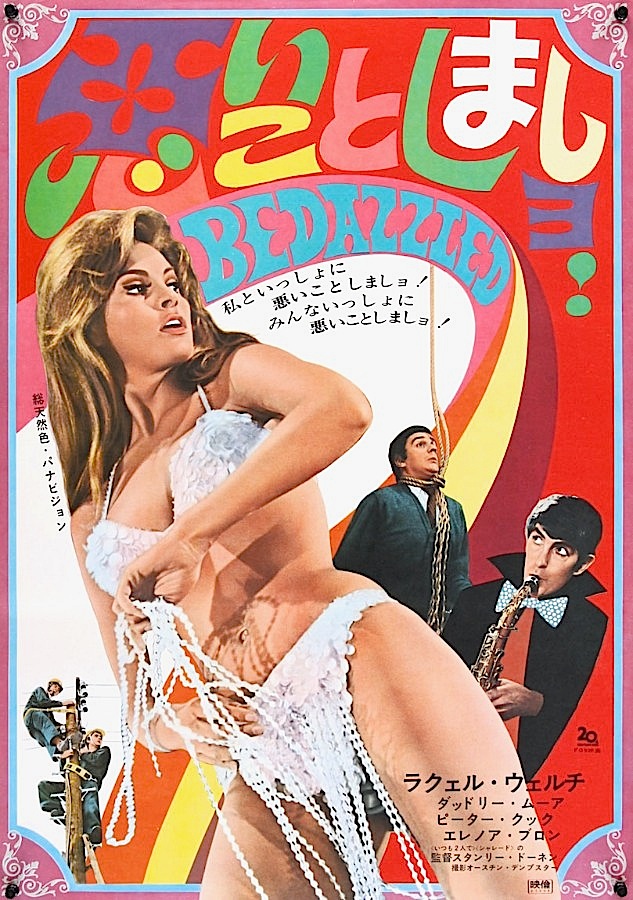
Japanese poster
Bedazzled has attained the status of a modest comedy classic, and remains an essential splash in the sea change in British and American comedy that preordained, among others, Monty Python's Flying Circus.


The few vintage extras on the DVD are welcome even if they're not substantial. In an amusing off-the-cuff promo, "Peter and Dud: Interview with the Devil," filmed on-set. Moore appears as a TV interviewer collaring George Spiggot, Esq., a.k.a the Devil. A five-minute clip gives us Cook and Moore discussing their shared history on L.A.'s "Paul Ryan Show" in 1979 when Moore was just about to hit stardom in Blake Edwards' 10.

Finally, a newer piece is a six-minute interview with Harold Ramis, director of the 2000 remake starring Elizabeth Hurley and Brendan Fraser, lauding the original. Also here are the American trailer and a click-through image gallery of 20 behind-the-scenes stills.

Music: Betty Carter
Near at hand: sandals off


Tuesday, June 29, 2010

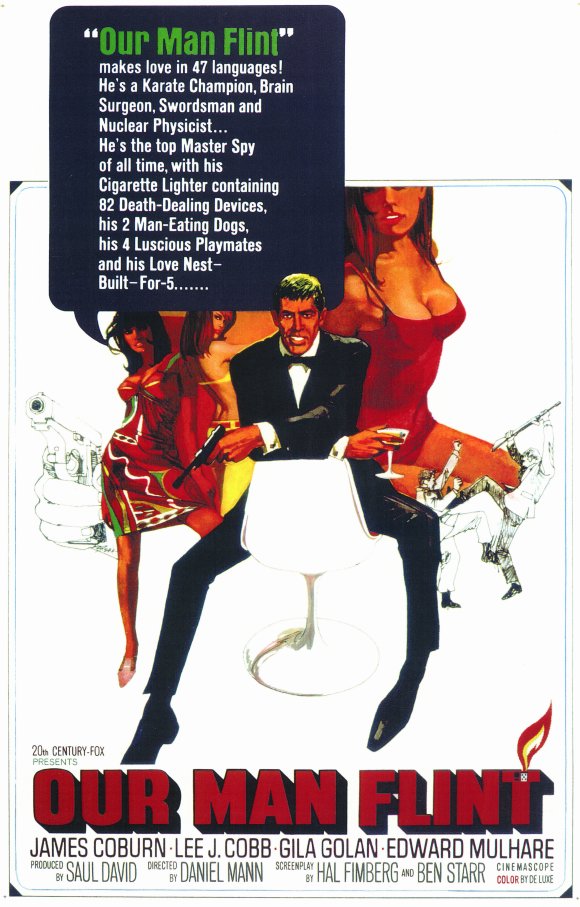
'Our Man Flint' (1966) & 'In Like Flint' (1967) — double-naught spoofs

My recent post about The President's Analyst gave me a jones for more James Coburn, and for days I was unable to shake it. Succumbing, I looked at the DVD shelves here and was surprised by how many Coburnpalooza opportunities I have available: The Magnificent Seven, The Great Escape, Charade, The Americanization of Emily, and others. All great and worthy gotta-haves for a movie buff, to be sure. I just hadn't noticed before how well Mr. Coburn and his Cheshire Cat teeth are represented in co-starring positions in my Movie Room.

Given that I was looking toward revisiting Coburn in a front-and-center starring role (my hand hovered over Pat Garrett and Billy the Kid, but I have to preset my head for Peckinpah), and given that The President's Analyst shares a dry martini shaker with the spy-movie parodies of its era, my Coburnmania choices were obvious: Our Man Flint and In Like Flint — two lesser films compared to those others, but a pair that benefit mightily by headlining Coburn in a star-making role that shows off his flair for charismatic humor as well as tough-guy cool. They're a twin set of James Bond spoofs that still manage to guilty-pleasure me (well, one of them does at least) while offering no pretense of being, say, The Magnificent Seven, The Great Escape, or Charade, or even Young Guns II.

By the time of the fourth Bond film, 1965's Thunderball, the 007 spy craze had exploded across pop culture, spattering the walls with poison blow-dart ink pens and steely-eyed, ultra-virile heroes. Perhaps the Cold War fantasy adventures of "real men" ruggedly vanquishing godless Commies and other evil empires, all while bedding improbably beautiful women, were a meat-eating guy's antacid against the discomforting reflux from real global tensions — not to mention home-grown indigestion embodied by the Beatles, antiwar protests, and the Women's Movement.

Plus, utilizing the Cold War for entertainment sure simplified things for moviegoers and TV-watchers. Head-throbbingly complex geopolitical currents were reduced to sprightly three-act action dramas that could be wrapped up before the closing credits rolled. Guns, gadgets, and girls were the primary colors of the comic-book spy universe.

Certainly there were serious-minded Bond imitators, such as the Harry Palmer series starring Michael Caine. But someone was bound to play the genre for laughs, and in short order the Bond spoofs outnumbered the Bond movies themselves. In fact, the '67 film version of Ian Fleming's first Bond novel, Casino Royale, hit the screen (with all the elegance of a paintball tournament) as a clowned-up comedy nearly 40 years before Daniel Craig got a case of the Vespers. Cocktail crooner Dean Martin starred in four mixed efforts featuring soused secret agent Matt Helm.

Even the women were allowed to flash their double-Os, such as Raquel Welch in 1967's Fathom ("the world's most uncovered undercover agent," natch) and Monica Vitti in Modesty Blaise ('66). Fresh-faced Andrea Dromm (The Russians Are Coming, the Russians Are Coming) starred as a secret agent and danced "the Shark" alongside Troy Donahue in 1967's Come Spy With Me, but the movie bombed so thoroughly it has yet to appear on home video.

On TV, The Beverly Hillbillies' Jethro Bodine figured that being a "double-naught spy"  guaranteed a life of "all that fightin' and lovin'," whee-doggie.


Then as now, a Hollywood trend didn't end until it was well past tired, and titles such as Dr. Goldfoot and the Bikini Machine and Dr. Goldfoot and the Girl Bombs, both starring our beloved Vincent Price plus his army of lethal fembots, made sure that we all tired quite thoroughly.


More recently (2006 and 2009) we get the two French "OSS 117" spy-film spoofs directed by Michel Hazanavicius and starring Jean Dujardin and Bérénice Bejo. These critical and box office successes drip with exacting 1950s-'60s period "look and feel" and float on Sean Connery look-alike Dujardin's natural charm as a clueless James Bond-Inspector Clouseau hybrid. Together Hazanavicius, Dujardin, and Bejo went on to international acclaim with 2011's The Artist.

The best of the spy-spoof bunch was 1966's Our Man Flint, a pop lampoon that remains a hyper-kitschy and entertaining time capsule. It helped make Coburn a full-fledged star as a Bond surrogate played so straight you could shave with him. Terrific with this dry, crackling material, Coburn is Derek Flint, ultra-secret agent called in to assist ZOWIE (Zonal Organization for World Intelligence and Espionage). Silly it is, yet this tongue-way-in-cheek action-comedy garnered favorable reviews and became Fox's third highest grossing film of the year.


Our Man Flint made a shrewd move by sticking to the Bond template. The brilliant and resourceful Flint works alone (although in this case as a playboy free agent rather than as a government company man), follows each clue to the next level, employs superhuman physical and mental prowess, beds gorgeous gals, gets captured, and prevents world domination in an orgy of destruction at the evildoers' secret volcano island. However, instead of being a bozo-nosed vaudeville like the Austin Powers movies, Our Man Flint out-Bonds the Bond films by respectfully retooling the familiar Bond elements and then turning the knob to 11.


Our hero, having just returned from teaching ballet at Moscow's Bolshoi, is called into service. ZOWIE agents have been killed while seeking the mysterious masterminds behind GALAXY, an organization controlling the world's weather and deploying natural disasters to hold humanity hostage. Their aim: a scientifically regimented utopian new world order (one that might actually be wonderfully beneficial if you can get past the whole Mad Scientist Dictatorial Domination thing).

While tracking down the lab-coated bad guys and enforcing The American Way, Flint performs impromptu surgery, stops his heart for prolonged periods, repeatedly annoys his flustered boss (Lee J. Cobb, Broadway's original Willy Loman) with his undisciplined ways, invents a Zippo lighter with 82 functions ("83 if you want to light a cigar"), traces a poison through a bouillabaisse recipe served in only one spot on Earth, jump-starts a man's heart via a lightbulb socket, wisecracks with British Agent "Triple-O Eight" (a Sean Connery lookalike, and SPECTRE gets a name-check), judo-chops gangs of bad guys, avoids disintegration in an electrofragmentizer, and finds his four live-in lovelies ensnared and brainwashed within GALAXY's Dr. Evil-like volcano H.Q.


Supported by Jerry Goldmsith's groovy musical score (really, it's marvelous), Flint does it all while keeping his tailored suits spotless, his demeanor cool, and his women satisfied.

There's little that approaches suspense here, mind you, something even the lesser Bond films managed to generate to some degree. In that regard you can rightly charge that Flint is too cool and competent for the narrative's own good; on the other hand, is worrying whether our comic-strip hero can overcome a sticky predicament the point of the Flint films to any degree?

Comparisons between Flint's pastiche heroics and the Austin Powers series are obvious. (Mike Myers frequently acknowledges the debt in the films.) However, Our Man Flint and its sequel, In Like Flint, are exaggerated burlesques of their own time and the pop superspy tropes that flourished then. Therefore, we can more accurately compare the Flint flicks with Scream or similar sendups of contemporary conventions and clichés that had grown so familiar to audiences that laughter was the only response left.

And guys, you may want to think twice about watching Our Man Flint with a wife or girlfriend. As part of their broad comedic approach, both Flint films unashamedly parade coprolitic sexual attitudes that would make even Mr. Powers wince.

By their nature, '60s spy movies unzipped a phallocentric revolt against the era's "sexual revolution." Our Man Flint is giddy and harmless while still being sexist in ways that no one could get away with today. Flint's sybaritic lifestyle includes a Playboy-ideal Manhattan penthouse staffed by a quartet of pliant babes who, it's clear, exist to provide him with anything he desires. The sexy villainess (Gila Golan, Miss Israel 1961) likewise falls into his arms and bedsheets within minutes.

The film's final third is an adolescent male Disneyland of bikini-clad centerfold models brainwashed to be smiling, willing "pleasure units" who "offer their bodies for the good of GALAXY." Although played for good clean "Yeah, baby!" fun, the scenes of Joe Blow henchmen queuing up to enjoy the sexual-slavery "pleasure units" like Happy Meals should leave even Maxim readers squirming.


Another raise of an eyebrow is occasioned when, as the supervillains' volcano lair self-destructs, we watch Flint and company cheer as hundreds of uncondemned people, including a crowd-scene's worth of those "pleasure units" we just saw, are blown to smithereens. The surprise crematorium for all those apparently disposable Happy Meals is greeted with the thrill of a Fourth of July fireworks display. The tone of comic camp keeps the moment from being consumed by any chance we'll think about its implications too hard (or at all), and yet, upon reflection ... yeesh.


The gender-sexual snark appears again in the sequel. Indeed, it's the very dough this lumpy pastry is baked from, and it's a big reason In Like Flint doesn't wash down quite as well.

"Women running the world? [laugh] You can't be serious!" That line, exclaimed with righteous derision by our hero, pretty much summarizes the plot and purpose of In Like Flint, which tries to top its predecessor by sending sardonic übermensch Derek Flint to Moscow, outer space, and the Isle of Uppity Brassiere Models. Instead it comes across as a flabby mix of the Batman TV series and a third-tier men's magazine.

In the New York Times, the headline above Bosley Crowther's review read, "Durable Hero Defeated by Deficient Script - Usual Bevy of Beauties Doesn't Help Much." After that the review itself can only be redundant.

In his review at the time, Roger Ebert's sigh was audible:
"The sexiest thing in the new Derek Flint misadventure, "In Like Flint," is Flint's cigaret lighter, which is supposed to know 82 tricks but actually delivers only five, of which one is the not extraordinary ability to clip Lee J. Cobb's moustache."


The plot has something to do with a space laboratory, a duplicate of the U.S. President, Lee J. Cobb in drag and not looking happy about it, a cryonics chamber, and a cosmetics firm fronting for an all-female organization (based in the Virgin Islands, oy) out to overthrow global male authority by (again) brainwashing women, this time via salon hairdryers.

(I hereby apply the label "Womanchurian Candidate" to the trope of brainwashing women for nefarious purposes. Ian Fleming's 1963 Bond novel, On Her Majesty's Secret Service, made a plot device out of brainwashing women with allergy medications, turning them into biological warfare delivery mechanisms.)


In Like Flint has its amusing moments, some fun action and sci-fi elements, and once again Coburn is appealing as the smirking superspy-scientist-athlete-adventurer who's now also a dolphin language expert, matador, and international ballet master. And of course he's still the irresistable "free love" representative whose mastery includes all women most guys only fantasize about.


Still, trying to connect the plot dots is a pointless exercise, especially after Flint confronts the empowered "ladies" and wins them to his side by telling them that they're being a bunch of silly-billies who shouldn't worry their pretty little heads so.

The fade-out sees Flint beginning an orbital three-way with two lovely cosmonaughties.

The best thing in this he-male mother-goosery is Jerry Goldsmith's sticks-in-your-head musical score that spoofs period flavorings. And as with Our Man Flint, the theatrical poster art by Bob Peak is a target acquisition for collectors.


In Our Man Flint the gender attitudes add to the fluffy fun when viewed in their anthropological context. Here they're just smug and condescending.

The Flint films tell us that beautiful "liberated" women with upright breasts and Space Age blonde hairdos are either disposable "pleasure units" or, if they're smart and assertive, castrating queen bees who really need (and want) a man's leadership; Derek Flint is naturally that man.

In Like Flint makes hand-waving gestures toward equality by giving Flint a superfluous "I don't compete with women" line and by showing the diabolical dames incapacitating squads of military men by batting their eyelashes and pressing their bikini'd flesh.

All the same, the clear message is that these little darlings who've merely tired of dish-pan hands should remember their place and not threaten the Natural Order of Things.

But it's all done as a comedy so wheeee it's okay.


Simply as a movie In Like Flint is further kneecapped by sloppy pacing, shoddy production values, and Lee J. Cobb looking like he's planning to make a stern call to his agent.

One of the poster treatments added this —
— which strikes me as, at best, an optimistic assessment of its target audience.

Directing it was 60-year-old Gordon Douglas. I'll step out on a limb here and suggest that Douglas might have been of the wrong generation to direct a film as "mod" as In Like Flint, compounding any issues we might attribute to the script.

Douglas' career was hardly distinguished, but it was interesting. His tenure reveals remarkable Hollywood staying power, starting as a teenager with Hal Roach and Our Gang shorts (first as a bit-part kid actor, later as a director), and building a résumé that included RKO serials such as Dick Tracy, the first and best of the 1950s Giant Bug movies, Them! (which yielded this favorite movie image), Laurel and Hardy's Saps at Sea, Bob Hope's Call Me Bwana, Frank Sinatra's The Detective, Sidney Poitier's They Call Me MISTER Tibbs!, and Elvis Presley's Follow That Dream.


Derek Flint (sort of) appeared onscreen one last time in Our Man Flint: Dead on Target, a 1976 pilot for a would-be Fox TV series starring Ray Danton. It watered down the "spy fun" premise and stunted the Flint character, and it is unwatchably awful. I'm not kidding: it's repellent even as a kitsch artifact. There's no "so bad it's good" here. Every regrettable thing you remember or have heard about the '70s — the hair, the clothes, the on-the-cheap look of the very worst TV that made it on the air — is on display, freighted further by terrible dialogue and acting that would make paper bags feel secure. For the curious, it's available on DVD as part of the three-disc Ultimate Flint Collection, if you can find it. If you do, I challenge you to sit through Dead on Target.

More interesting is Flintlock, an unproduced teleplay by none other than Harlan Ellison. It was a would-be pilot for a proposed 1972 TV series. You can find it reproduced in Ellison's retrospective collection, The Essential Ellison. Ellison's script also revises the character and tone quite a bit, and I don't think it altogether works dramatically (and potential directors must have scowled at seeing their camera directions provided for them in detail), but at least it's the most literate and potentially intriguing approach to the Derek Flint character.


Music: Arvo Pärt, Alina
Near at hand: A program from last Saturday's 2010 Science Fiction Hall of Fame induction ceremony.

Thursday, June 17, 2010

The President's Analyst (1967) — Spy vs. spy, repeat as necessary

A couple of years ago, the New York Film Forum pullquoted me to help promote a public screening of The President's Analyst, a mordant Cold War comic satire starring James Coburn. It was the first time (to my knowledge) that I've been positioned right next to Roger Ebert, and I was extra pleased that it happened with a movie I like this much.

Among the quotes pulled was this one:
"If Philip K. Dick had worked for Mad magazine, he might have come up with The President's Analyst." *
That still works as one of my better examples of cinematic pith, and so here it is again as I rewatch the movie once more. It's a visit to the Favorite Films stack I'm apt to do at least once a year when feeling the urge to see this cast working so well together. That despite the invariable yearning afterward to see them teamed up again, a recurrence that never transpired.

I hold a special affection for, and interest in, movies from the 1960s, and The President's Analyst is every inch a bottle of distilled, carbonated 1967. Its daisy-chain structure pushes Manhattan psychoanalyst Dr. Sidney Schaefer through the "doors of perception" you'd get if the title sequence of TV's Get Smart included a Jim Morrison soundtrack. Coburn plays Schaefer with a wry straight-man comedic prowess that both complements and counterpoints his super-spy spoofery in Our Man Flint ('66) and In Like Flint ('67).

1967 being the year of Sgt. Pepper and Monterey, The President's Analyst played straight to its youth audience. Its impudent counterculture cynicism lampoons the squares and their Cold War tribalism, obsolete values, police-state bureaucracies, and robotic conformity. Schaefer learns that drugs and sex are freeing, and that the running joke we call The Establishment is more neurotic than even Abby Hoffman could have imagined.


In The President's Analyst, the POTUS is "overworked, overtired, overburdened." So the FBI and CIA  join forces (grudgingly) to press Schaefer into service, on call 24/7.

At first the mod, urbane Schaefer is ecstatic at such an august promotion, and the job of unburdening the "great man" is an exhilarating rush.


But soon he discovers that he's been dropped down the rabbit hole into a spy-vs.-spy world of espionage, counter-espionage and counter-counter-espionage, where paranoia really is the most sensible response. After the strain of his top-secret sessions drives him to a nervous breakdown, he flees to the outside world.

Once there, his insights into the president's brain make him the priority target for international abductors and assassins (such as the Canadian Secret Service disguised as a Beatles-like rock group). Worse, the FBI (headed by a sour, morality-obsessed J. Edgar Hoover homunculus) wants the hapless shrink dead in the interests of homeland security.

Schaefer's disorientation and increasingly legitimate paranoia — even his lover Nan (Joan Delaney) isn't what she seems — thrust him from one set piece to another.


If The President's Analyst shows us political and nationalistic loyalties that are malleable, or at least dysfunctional, to the point of being expendable, it shows us something similar about commonplace labels here on the domestic "real America" level.

Schaefer takes refuge with the Quantrills, a self-described "typical American family" of militant "liberals" armed to the teeth against right-wing "fascists" who "ought to be gassed." The father (marvelous William Daniels) boasts that they're for "Negro" rights, yet Mom (Joan Darling) offhandedly calls going out for Chinese food "eating Chink"; Arte Johnson's Dragnet-clone FBI agent reprimands their wire-tapping boy for using such bigoted argot. One minute Mom is asking Schaefer if he reads Gourmet magazine, the next she's delightedly kick-boxing international killers while dead-eye Dad blasts away with his .357 Magnum. Earlier, he admonishes his son Bing to never confuse the family's "car gun" and the "house gun."


I do get a sense that the Quantrills' eager young son has a steady career ahead of him later on:
Bing: "Are you going to kill Dr. Schaefer?"
FBR Agent Sullivan: "Yes, son, we're going to kill him."
Bing (beaming):"Oh, boy!"
Elsewhere Schaefer foils an ocean abduction by turning his psychiatric training against his captor. Pretty soon he's finding his groovy LSD and free-love vibes while on the lam with a band of hippies.

Supporting it all are first-rate performances by Coburn (who gets to chuck his patented sangfroid out the window), Godfrey Cambridge as a CIA agent, and Severn Darden as Cambridge's garrulous, likable Soviet counterpart.

Along with Watermelon Man, this is the finest movie work we have from Cambridge, who had made his name as a stand-up comedian. While posing as one of Dr. Schaefer's patients in the opening scene, his moving soliloquy — recalling an incident of schoolyard racism that occurred when he was five years old — immediately wins us to the side of a character we've just seen impassively stabbing another man through the heart on Seventh Avenue.

Darden's Russian spy, Kropotkin, is likewise an affable and pleasant fellow who's also a cold professional killer. (His proficiency as a spy and assassin comes rooted in Oedipal issues.) Cambridge and Darden have such a pleasurable sporting rivalry that it's a shame they weren't spun off into their own movie.

Darden, in fact, is so appealing and surprising and watchable here that I wish I could point to a shelf-load of other films that gave him co-starring roles as strong as this one. Regrettably, his filmography didn't exactly take off after this, being mostly onesie-twosie TV appearances in the '70s and '80s. Reading about him on the Web, I get the sense that he and Hollywood were not an easy mix, and that he was never better than when on a Chicago comedy stage. (You can see him with Coburn a year earlier in Dead Heat on a Merry-Go-Round.)

Writer-director Theodore J. Flicker was, like Darden, a foundational alum of Chicago's Compass Players, which later evolved into The Second City improv troupe. Flicker's own award-winning Greenwich Village improv troupe, the Premise, included Cambridge, Darden, and Joan Darling. So if you get the feeling that he's making it up as he goes along, chalk that up to a period modular comedy style à la The Party or The Magic Christian. The scenes beaded together work, some brilliantly, though the whole falls just short of the sum of its parts. But, man, I do love the parts.

The President's Analyst benefits on DVD as multiple viewings reveal Flicker's witty and telling little details that come to light only after you've seen the whole movie. For instance, during the Greenwich Village chase scene (shot largely in front of the venerable Cafe Wha?) as Dr. Schaefer is besieged by an onslaught of attackers, notice in the background the interaction between an assassin and a phone booth. And what's the logo on that van parked outside the Quantrill family home where he hides out and makes a "top secret" call?

Someone defanged a bit of the screenplay's satire; notice that the acronyms "FBI" and "CIA" are ungracefully redubbed as "FBR" and "CEA." Perhaps that was because of how Flicker depicts the two competing intelligence agencies. The FBR mans its forces with deadpan, black-suited, by-the-book drones. While gathered in the drab, stark office of their drab, stark chief, Henry Lux (Walter Burke), they stand at attention in rank-and-file rows and apparently must be no taller than Lux, who bears all the stature of an ugly garden gnome. Meanwhile, the CEA's tall, avuncular director (Eduard Franz) is as calm as a cup of chamomile tea and his recruits lounge in his comfortably appointed office like college poetry students at the feet of their favorite old professor.
CEA Director Ethan Allen Cocket [defending Schaefer's right to keep his live-in girlfriend]: "My dear Mister Lux, no man is an island; most of us require the warmth of human companionship."
FBR Chief Lux [as if he's spitting out a snail]: "Poppycock!"
On his website, Flicker wryly synopsizes this part of his career thusly:

1967
Wrote and Directed "The President's Analyst."
A huge hit!
I was elevated to Hollywood's "A List"

1969
Disaster!
J. Edgar Hoover had "The President's Analyst" removed from the Theaters.

1969
Off the "A List"


Nowadays The President's Analyst comes with a patina of yesteryear kitsch beyond the in-period send-ups Flicker built into it. Of course some of its components are dated, such as the sub-Ken Russell LSD trip and the idyllic hippies. Nonetheless, a scene with Schaefer making love in a field with a flower-power nymphet named Snow White (the fetching Jill Banner), while multinational agents bump off each other trying to nab him first, remains some sort of perfect poetic metaphor.


On the other hand, several prescient elements foreshadow more recent history: manipulative autonomous megacorporations, government surveillance of private citizens, an unsporting rivalry between the CIA and FBI — today all that still glints like newly polished silver. Exchanges such as this...
Soviet agent Kropotkin: "Are you trying to tell me every phone in the country is tapped?"
American agent Masters: "That's what's in my head."
Kropotkin: "Don, this is America, not Russia!"
... now come with a discomfiting Patriot Act freshness. Sure, we laugh, but through clenched teeth. (You know the adage about "The more things change...")


The movie's punch line is both retro and 2010 hip: the insidious supervillain, operating behind the scenes and more powerful than governments, became obsolete in 1984 — but you'll remember its charmingly illustrated master plan next time you upgrade your ever-shrinking cell phone.

(Alert: Big spoilers.)


You know that Schaefer's trained psychoanalytic bearings have been realigned the instant circumstances transform him from an unflappable leather-couch counselor to a machine-gun spraying action hero with his own Die Hard-worthy catchphrase: "Take that, you hostile son of a bitch!"


Setting up the fade-out's sardonic absurdist sight gag, Schaefer essentially "takes the red pill" and stumbles into a demented backstage reality that predates Wachowskian Matrix head games — or Philip K. Dick — by 30-odd years.


Paramount's 2004 DVD of The President's Analyst is a bare-bones disc, but long-time fans of the film still have plenty to be happy about here. The print looks super: vivid and clean, and now it's back in its original Cinemascope widescreen. The audio is excellent in DD 1.0 monaural, giving Lalo Schifrin's musical scoring a clean, crisp presence. During Schaefer's early Manhattan reverie, Schifrin's "Look Up" is the grooviest version of "Joy to the World" in the movies.

Because of problems over music rights, previous home video editions deleted two songs performed on screen, the edits masked by substituted music and trimmed footage. This DVD restores that original music and footage, most memorably "Inner Manipulations" from the hippie songster played by Barry McGuire (whose non-cinematic "Eve of Destruction" remains an Oldies radio fave).

However, this DVD regrettably does not restore (or include as a "deleted scene" extra) a scene that's been missing from every print of The President's Analyst I've seen. The scene, early in the movie, shows us Dr. Schaefer first meeting his soon-to-be lover Nan at an avant-garde underground movie. A few press images from the scene show up with a little Googling:


Cutting that scene may have helped the narrative flow more smoothly or briskly. Or maybe it just didn't work as a scene for some other reason. Including it would provide context to Sidney's exclamation to Nan about his happiness in the random chance of their apparently recent meeting, a meeting that (later scenes demonstrate) likely wasn't as accidental as he believes. Those images seem to have accompanied the initial press packets at the time of the film's release (the center one appeared with Roger Ebert's review, among others), so I wonder if the scene was cut after its initial public screenings.

The DVD's English subtitle option is so thorough that when Severn Darden's agent Kropotkin meets with his boss at the Kremlin, their exchange of authentic Russian dialogue is, only for home viewers with the subtitles turned on, fully translated in the captioning.

There are no "featurettes," retrospective interviews, or other extras, although there sure should be. A commentary track by Flicker would be welcome, yet I get the impression from his website that these days Flicker would rather we remember him as a (very accomplished) sculptor in Santa Fe. "Escape money" is how he describes the success of his TV creation, Barney Miller.

The good news is that a 2008 biopic, Ted Flicker: A Life in Three Acts, goes a long way toward filling that gap, if you can catch it:


* Addendum:
Screenwriter Larry Karaszewski (Ed Wood, Man on the Moon) adds a fine narration/appreciation to the The President's Analyst's trailer at the website Trailers from Hell. He opens his commentary by noting: "A critic once wrote, 'If Philip K. Dick worked for Mad magazine he might have come up with something like The President's Analyst'." I just friended Mr. Karaszewski on Facebook. His exegesis fills in some behind-the-scenes info I was not aware of when I wrote this post.

Music: Susannah McCorkle, Hearts and Minds
Near at hand: Neil Gaiman and Al Sarrantonio's Stories.