"Last week I was again in Norway for shooting northern lights. This time I
was very lucky, there was a lot of activity on the sky especially on
the 24 January. The scenes are from Ravnastua, Skoganvarre and Lakselv.
The first two days I had a lot of trouble with frozen Cameras. It was
-25°C (-13°F) and after 1-2 hours of shooting the lens was frozen."
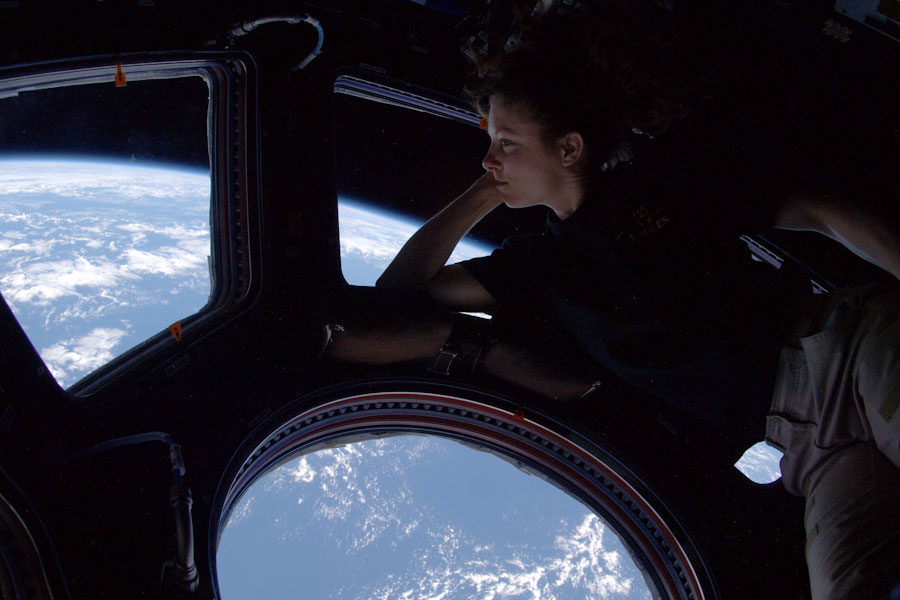
The Earth at night, as seen by astronauts on board the International Space Station. The video is amazing, eerie, humbling, and jaw-droppingly gorgeous. Watch it full-screen.
If the natives of Kepler-16b are irked because we've nicknamed their home
planet "Tatooine," I hope they don't point a big space arrow labeled
ALDERAAN at us.
Mike Brotherton, University of Wyoming Associate Professor of Astronomy, speaks about science in movies at the Summer 2011 Saturday University event in Jackson. Does it matter if Hollywood gets the science right in movies? Entertainment informs opinions about science and scientists and is stealth education for better or worse. Good science is rare in the movies, but perhaps even bad science offers teachable moments. In this talk, he illustrates examples of good and bad science in cinema.
Mike organizes and teaches Launch Pad Astronomy Workshop, with the goal of improving the portrayal of science in books and films. This clip is almost an hour long, but full of interesting perspectives.
As a former astronomy teacher/presenter and scriptwriter/producer for planetariums, as well as a movie lover and, like Mike, a member of SFWA, I love a science fiction movie or TV show that makes an effort to get the science right while honoring its paramount obligations to story and drama. Meanwhile, I grind my teeth when science is ignored simply out of laziness or willful ignorance, especially when the choice of respecting the science (and therefore our intelligence) could have honored and even enhanced the story and drama. And there are cases, such as Mike's example of the stars in Titanic, when getting it right is just as easy as getting it wrong, so why not get it right for those of us who notice? J.J. Abrams' Star Trek, as much as I love it, is a case in which my teeth-grinding could have been forestalled with a few pen strokes that simultaneously worked in service to the story's narrative and tension. Oh, if only he'd seen my Star Trek show produced in cooperation with Paramount.
Music: Miklós Rózsa
Near at hand: Oddly inscribed scabbarded short sword that, I swear, came with the house.
This remarkable view captured by astronaut Ron Garan looks down on a Perseid meteor. From Garan's perspective onboard the International Space Station orbiting at an altitude of about 380 kilometers, the Perseid meteors streak below, swept up dust left from comet Swift-Tuttle heated to incandescence. The glowing comet dust grains are traveling at about 60 kilometers per second through the denser atmosphere around 100 kilometers above Earth's surface. In this case, the foreshortened meteor flash is right of frame center, below the curving limb of the Earth and a layer of greenish airglow.
A larger version (4256 x 2832, resolution 240) with more info is at APOD.
Rhapsodic reviews for Woody Allen's Midnight in Paris are still coming in. As a long-time Woody fan who has chewed his lip in dolorous heartache ever since Celebrity clubbed my baby seal before my eyes in 1998, I've been despairing that his long, slow derailing was unstoppable. Now my spirits are lifted thanks to the likes of Glenn Kenny and Kent Jones, and I'm anxious to see Midnight in Paris. What a relief to be able to type that.
NPR: Myth, Art Life, Science And ... 'Thor' — I haven't seen Thor yet (and frankly will likely wait until it's available via Apple TV), but as a former planetarium writer-producer-educator I appreciate Adam Frank's stance in this piece: "As an astronomer, I couldn't miss the variegated interstellar clouds in hues of cobalt and magenta that make up much of the film's cosmic background. They are taken right out from images captured by telescopes like Hubble, Spitzer and Herschel. Best of all (for me at least), at the end of the movie the filmmakers take us on a long, rolling journey through these light-year long sculptures."
Cannes Film Festival: Can Harvey Weinstein take a silent movie to the Oscars? -- "Funny, sly, touching, nostalgic, and interestingly relevant, The Artist will be a unique presence in this year’s awards race to say the least." The Sun Times' Barbara Scharres wasn't as impressed. (She also reports on the film Code Blue: "...a large part of the audience simply decided that they'd had enough and started streaming out. I've never seen anything to match it at Cannes. So many people were leaving that the guards had to prop open the exit doors although the film wasn't over.")
Thanks to Glenn Erickson, I'm now addicted to "Trailers from Hell." Just about an hour ago, Elizabeth and I were enjoying several TfH selections together when I clicked on The President's Analyst, a favorite film that I've given the Open the Pod Bay Doors, HAL treatment to here. At TfH, the trailer gets a fine narration/appreciation by screenwriter Larry Karaszewski (Ed Wood, Man on the Moon). Little did I know that he'd open his commentary by noting, "A critic once wrote, 'If Philip K. Dick worked for Mad magazine he might have come up with something like The President's Analyst'." That critic was me, from back when I wrote that sort of thing for more remunerative venues. Mr. Karaszewski's exegesis fills in some behind-the-scenes info I was not aware of when I wrote my original review or the subsequent Pod Bay Doors post. Wowza! Now I'm famous on the Internets! (And I just friended him on Facebook.)
Oh, speaking of Glenn, he sent me this:
Music: Bill Evans
Near at hand: Sounders FC season members scarf
As I've mentioned elsewhere in this "mostly movies" blog, astronomy is also a significant passion of mine. Some of my most satisfying — professionally, creatively, academically, even spiritually — career work has happened under the astronomy dome.
So I get a tingly thrill when those two areas converge in the great big Venn diagram of my life.*
So here's a public tingly thrill for Roger Ebert. While I've been enlightened and entertained for years by his film reviews and commentary, over the past few years he's become someone whose expanded writings on diverse topics in various media I greet with an appreciative, admiring fist-bump, sometimes a vocal "Oh hell yeah!" He occasionally waxes into matters cosmic, and his latest journal entry almost sounds like one of my planetarium shows.
"On this dot of space and in this instant of time, the human mind is a great success story, and I am fortunate to possess one. No, even that's not true, because a goldfish isn't unfortunate to lack one. It's just that knowing what I know, I would rather be a human than a goldfish."
When I read his post, I can hear it in Carl Sagan's voice, which takes me back to one of the reasons why I got into the field in the first place, back when. (Isaac Asimov played a part too when I was in fifth grade, in a serendipitous karmic "circle of life" payoff years later. I may tell that story here sometime.)
While the past several years have been a (generally, generously speaking, squinting through one eye) not too objectionable time to be a movie buff, we live in an awesome** time to be into astronomy, whether as a pro or an amateur enthusiast. I sure would love to see those two fan-thusiasms of mine converge more often, especially on the screen.
So consider this post a public fist-bump, with an "Oh hell yeah!" thrown in too. An excuse to swoon dreamily at Jodie Foster at the Very Large Array ain't too bad either.
* Oh, it's a rare convergence. I'd make a first-rate astro consultant for the movies. But do they call me? Noooooo. I wrote and directed the one and only Star Trek astronomy show, so if you know J.J. Abrams please send him my way before his Star Trek sequel starts shooting. The supernova that "threatened to destroy the galaxy" chaps my ass every time. So does that whole "Delta Vega" thing. And....
Winter is my favorite time of the year for night sky-watching. Earth is arcing through the part of its solar orbit that faces out toward the constellations Orion (a professional and romantic touchstone for me and Elizabeth), Gemini, Leo, Canis Major and Minor, the Pleiades star cluster, and more. It's something I look forward to every December, and on nights between now and February I'll get to feel ice forming on my mustache. One of my first public shows was a gorgeous planetarium production on the subject (the winter sky, that is; not my icy mustache).
Of course, living here in Seattle doesn't present enough opportunities for clear-sky viewing, but I take 'em when I get 'em.
There may be a film reference I could drop in here to justify this post in a "mostly movies" blog, but that's just not where my head is at the moment. (Oh, okay — "My God, it's full of stars!" There.)
Instead, in about ten minutes I'll be walking with Kai down by the water at Alki under the first blue-sky day we've had since November 23. (That day's Facebook update at 7:07 am: "It may be 23° with snow out my back door right now, but the sky is so clean and clear that I can't recall the last time the moon, 96% full, was so crisp and vivid through my binoculars. Gorgeous detail.") If the clear sky holds true into tonight, I'll be out there rather than in here. Although I will, no doubt, make sure a hot beverage is waiting for me when I get back inside. (Memo to self: Google search for drinks hot Bushmill's).
Los Angeles has been communally celebrating with Ray Bradbury Week. As for me, I sent an email to Mr. Bradbury's agent asking about securing the rights to create a new theatrical adaptation of The Martian Chronicles for Seattle's Book-It Repertory Theater.
Like so many people out there, my history with Ray Bradbury starts with devouring The Illustrated Man, Fahrenheit 451, R is for Rocket, The Golden Apples of the Sun, Dandelion Wine, and especially The Martian Chronicles when I was in junior and senior high school. Since then I've always kept up with his writings, and carried those old paperbacks with me as I moved here and there and elsewhere across the country for college or career or coastal views. Here in my office I have three different editions of Chronicles. So, yeah, it's one of my touchstone "desert island" books and he's been a writer I've happily grown up with. Even when some of his work has been subpar and his personal proclamations slip into right-wing crankitude like Grandpa Simpson waving his cane, he still occupies special bookshelf space in my heart and his best work remains eminently re-visitable "comfort reading" decades on.
Like me, Bradbury has always possessed a love for the theater, for good stories well-told by skilled, talented people on a stage in front of willing audiences. Not surprisingly then, he has adapted The Martian Chronicles and Fahrenheit 451, plus a dozen or so of his stories, for the stage.
Years ago, while working on my M.A. in theater, I hit upon the notion of producing and directing a couple of his plays, adaptations of his stories "Kaleidoscope" and "Pillar of Fire." Meanwhile, creatively indulging a long-time love of astronomy, I worked as a show presenter and educator in the local planetarium. So what better place to stage the show than in the planetarium?
Aided by like-minded artists, musicians, and actors, we used the facility's unique visual technologies to place our strong repertory cast — the newly inaugurated Glass Goblin Theater Company — on an audience-encompassing Martian landscape, in a futuristic graveyard, and even adrift plummeting through deep space. All scene changes, plus special visual and audio effects, were as easy as a flip of a switch on the planetarium control console.
Best of all, A Night of Delicate Terrors: 2 Plays by Ray Bradbury went live with active cooperation, encouragement, and input from the plays' author. During the rehearsal phase, Ray — he asked me to call him Ray, insert fanboy squeal here — and I exchanged a large amount of mail and spoke on the phone a number of times, with him sending me his thoughts on theater as well as articles he'd written and even his own copies of scripts he'd created.
My goal was to create a kind of theater that was (1) entertaining and meaningful to traditional theatergoers, (2) "modern" in a way that attracted and engaged people who never before had set foot in either a playhouse or planetarium, (3) commercially viable (we made money!), and (4) consistent with Ray's notions and philosophies about an "intimate" theater that provides a physical, elemental experience that's not just three-dimensional TV. We succeeded.
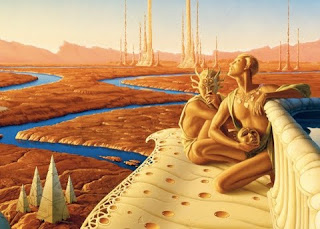
My one regret was that he was unable to join us at the show itself. So afterward I sent him the press notices and a collection of production photos. Much later I was pleased to hear from his publicist that a copy of the show poster hung in Ray's dining room. A framed copy inscribed by Ray in silver ink hangs here in my house. (Just moments ago as I sit here, while Google-searching for the Martian Chronicles image at the top, I discovered that two years ago someone at Wired.com liked that poster well enough to cop-and-crop it for their own Happy Birthday piece on him.)
The show was a hit. It capped my Master's degree in theater, after which we staged another show in the same venue, Lunacy, a seriocomic satire about the history of women in space exploration.
Together those shows opened a door to a (wholly unanticipated) career in the planetarium field with a position as Astronomer Intern at the renowned Strasenburgh Planetarium in Rochester, NY. My boss there, the chief producer, was also a theater man with his own company, so he appreciated the value of enhancing the 60-foot dome with a dash of showmanship when carrying audiences to the stars.
Later, that feather in the cap took me to Portland, OR, where I was hired as the planetarium production coordinator at the big science museum there. It was a job I loved and one that afforded still more creative high points (playing in the Star Trekuniverse among others).
Ray and I maintained our correspondence. He sent me his script to Leviathan '99, a deeply poetic (probably too much so) space-going radio play interpretation of Moby Dick. Along with it was a cassette tape of the BBC production starring Christopher Lee. I pitched hard for it as a new project at my new planetarium job, but the higher-ups wouldn't bite. It put me in the uncomfortable position of having to say no to Ray Bradbury. Crap.
At the console, Strasenburgh Planetarium
I'm not doing planetarium work now, but I miss it and its unique stimulations and creative opportunities dearly. Mr. Bradbury — back to respectful formalities now — and I have exchanged some mail and Christmas cards over the years. In one of them he included one of his poems, "If Only We Had Taller Been," and before I read it I wondered, Is this about me being only 5'4"?
My story, "Great Works of Western Literature," appeared in the Sept. '94 issue of Fantasy & Science Fiction along with Bradbury's "From the Dust Returned" (which he later expanded into a novel).
More recently, he and I have shared space in a college textbook, one of those fat Norton-style literature anthologies. It's the 4th edition of Literature and Ourselves: a Thematic Introduction for Readers and Writers (New York: Longman, 2003), for courses in second-semester freshman composition and intro to world literature.
Within the 1500-page collection, among the Virginia Woolf and Geoffrey Chaucer, nestled there between Hemingway, Fitzgerald, Faulkner, Vonnegut, Poe, cummings, Sophocles, Shakespeare, Joyce, Oates, Eliot, O'Connor, and other deep-hitters, my previously published novelette, "What Dreams Are Made On," was reprinted as part of the thematic section Imagination and Discovery. Its prose fiction segment includes Mark Twain, Woody Allen, Ray Bradbury, me, and Louise Erdrich.
On a preface page kicking off that section, the editors paired us up for some student deep-thinkery:
"...You might choose to explore what Ray Bradbury is implying about our present by showing us one version of the future in 'There Will Come Soft Rains,' or you might ask what Mark Bourne is saying about human nature as he describes people who fill their lives primarily with vicarious experiences...."
My byline appearing near his in a literature textbook was pure kismet; I had no idea what else was going to be in that section until I received my copy of the book. It was both thrilling and humbling, and you bet I sent him a little note about it. My fiction, such as it is, has not again (yet?) been represented in such august company. Oh, and please excuse me while I give another fanboy shout: Woody Allen! Mark Twain! Holy shit!
As I mentioned at the top, earlier this week I wrote to his agent. I did so at the suggestion of his daughter/manager and at the behest of the Book-It Repertory Company, who have been itching to apply their own impressive "Book-It style" to a Ray Bradbury title or three during its twenty years as a mainstay in Seattle's theater scene. They have approached him before, but a deal couldn't be struck. So maybe I can provide a friendly "in" as a liaison between two creative forces I enjoy so much. My hope is that I'm the one who gets to adapt The Martian Chronicles. Wouldn't that be cool?
In the meantime, here's another personal birthday greeting — this one from Rachel Bloom of the Upright Citizens Brigade (oh, to be back in New York again!) — that, boy oh boy, sure has made the rounds this week.
According to this interview with the well-read Ms. Bloom in the Seattle PI's Booktryst blog:
"Writers are thus the pinnacle of intelligence. While actors are great and awesome, writers literally create new worlds from scratch. What is sexier than that? Personally, I don’t know why every person out there isn’t dating a writer."
So, to answer the second obvious (to me) question: Yes, suddenly I have an even greater incentive to finish this novel. In the meantime, Rachel, may I interest you in some of my published short fiction?